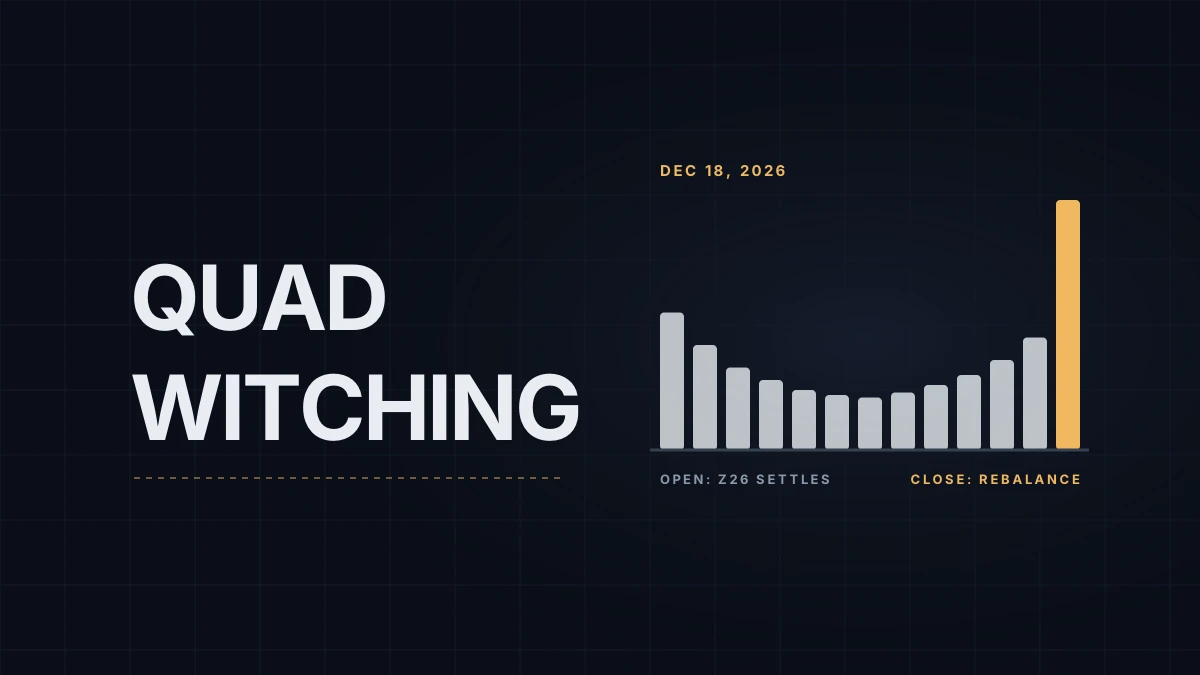
Friday, December 18, 2026 is the third Friday of December, and it stacks three events on one session. The December NQ contract settles at the open. Index and stock options expire in what is usually the largest expiration of the year. And at the closing price, funds that track the Nasdaq-100 rebuild their portfolios for the index's annual reconstitution. Each one has its own clock, so the day is easier to read in three parts, and with NQ at $20 a point (the NQ vs MNQ tick and point value guide has the arithmetic), even a 50-point swing in the closing minutes costs $1,000 per contract.
Morning: the December contract settles
NQ 12-26 stops trading on the morning of the 18th and settles in cash against a special opening quotation of the Nasdaq-100, built from the opening prices of its stocks; the NQ expiration post explains the mechanics. Most traders have long since moved to March. CME's customary roll date this quarter is Monday, December 14, and the platform side of the switch is in the NinjaTrader rollover post. If you are still in December on Friday morning, you are in a contract that is about to stop existing.
Midday: the largest expiration of the year
"Quadruple witching" originally meant four products expiring together: stock index futures, stock index options, single-stock options and single-stock futures. Single-stock futures disappeared from US exchanges when OneChicago closed in 2020, and CME relisted them only in July 2026, but the name stuck, and Nasdaq still notes that December expirations are typically the biggest of the year. The effects of a large expiration, from pinning near big strikes to the hedging that disappears once the options are gone, are covered in the monthly opex post and apply here at a larger scale.
Close: the Nasdaq-100 reconstitution
The Nasdaq-100 is reconstituted once a year, timed to the December quadruple-witching day. Nasdaq ranks eligible companies by market value, keeps most existing members, and swaps the ones that fall too far down the list; in December 2025 it added six companies and removed six. The weights are rebalanced at the same time, and the index's weighting scheme, described in the Nasdaq-100 weights post, means the largest names can see their share trimmed or raised.
The timing follows Nasdaq's index rules. In 2025 Nasdaq announced the changes after the close on Friday, December 12, effective before the open on Monday, December 22. Under the same rules, the 2026 list comes out after the close on Friday, December 11, effective before the open on Monday, December 21. That puts the funds' trades at the closing price on Friday, December 18.
The size is what makes it matter for NQ. As of December 2025, more than 200 products tracked the Nasdaq-100, with over $600 billion in assets. Funds that track it need to own the new composition at the close, so they buy the additions and sell the deletions in the closing auction. On the same Friday the S&P 500's quarterly rebalance takes effect after the close as well.
| Time (ET) | CET | What happens |
|---|---|---|
| 9:30 AM | 15:30 | NQ 12-26 settles against the opening quotation; options with morning settlement expire |
| During the day | Expiring options lose their hedging influence as the session goes on | |
| 3:50 PM | 21:50 | Exchanges start publishing closing-auction imbalances |
| 4:00 PM | 22:00 | Closing auction: index funds trade at the closing price |
How the session tends to behave
The volume at the close on these Fridays is among the largest of the year, and NQ can move sharply in the last ten minutes as the imbalance numbers come out, then go quiet. The direction of those moves is hard to predict, because buying of additions and selling of deletions partly offset each other. Before the event, the stocks being added or removed often move between the announcement and the effective date, which shows up in single stocks more than in the index.
Traders plan the day in a few ways. Some trade the morning and are flat well before 3:50 PM ET. Some avoid the session altogether, because a settlement, an expiration and a rebalance in one day make the usual levels less reliable. A few trade the closing imbalance on purpose, which is a different strategy from intraday trading and needs its own rules. Whatever the plan, the next week is shorter than usual, with Christmas Eve on Thursday the 24th, and the NQ holiday trading hours post has the times.
Educational content, not investment advice. Futures trading involves substantial risk of loss. Examples are for illustration only. Read the full Risk Disclosure.