Loss Aversion and the Disposition Effect: Why Traders Cut Winners and Hold Losers
Selling a winner feels like locking in a gain. Closing a loser feels like making it real. That asymmetry is the disposition effect, and it shows up in stock accounts, on the CME floor and in Korean index futures. What the studies found, how to spot it in your trades, and two rules that blunt it.
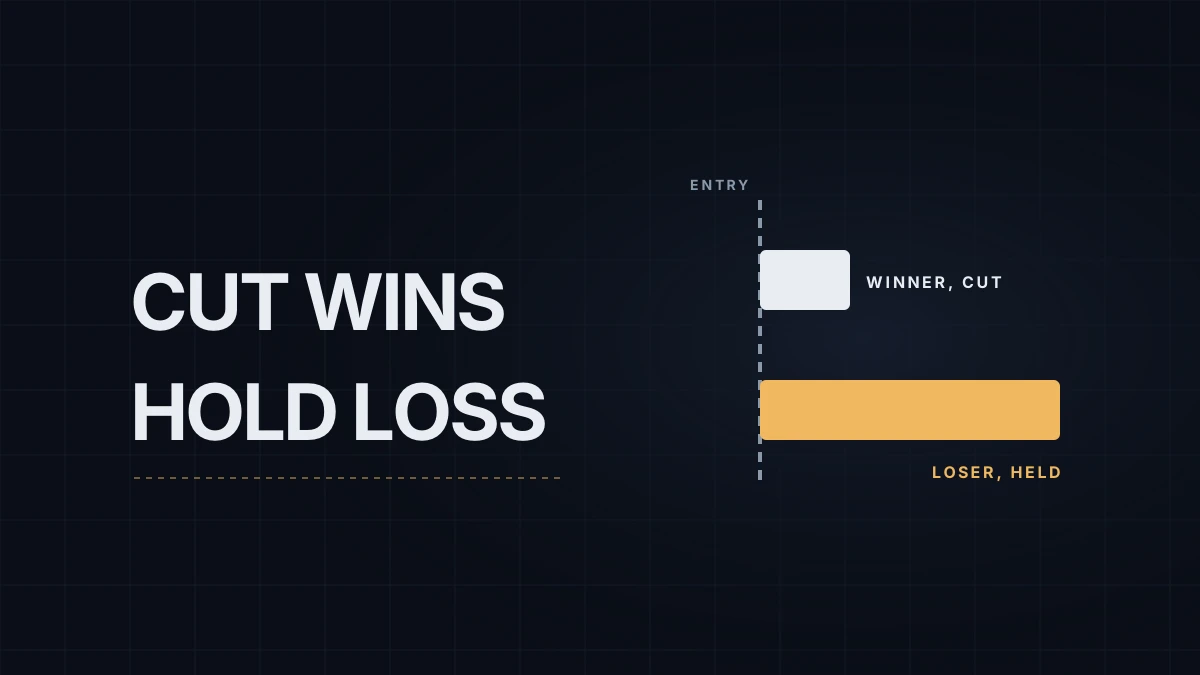
A trade is up 20 points and you close it, because the profit might disappear. Another trade is down 20 points and you hold it, because it might come back. Both decisions feel careful. Together they produce a trader whose winners are small and whose losers are large, which is the shape of a strategy that loses money even with a decent win rate.
A chart, read the way the price chart guide describes, tells you where a trade should end. The disposition effect is what happens between that plan and the click.
Where the name comes from
In 1979 Daniel Kahneman and Amos Tversky published prospect theory, a description of how people decide under risk. Two of its findings matter here. People judge outcomes as gains or losses from a reference point, and for a trader that point is the entry price. And people treat the two sides differently: with a sure gain on the table they avoid risk and take it; facing a sure loss they prefer to gamble on getting back to even. Later work put the weight of a loss at roughly twice that of an equal gain.
Hersh Shefrin and Meir Statman applied this to investing in 1985 and named the result the disposition effect: the tendency to sell winners too early and ride losers too long.
What the studies found
The best-known test is Terrance Odean's 1998 study of about 10,000 accounts at a US discount broker, covering 1987 to 1993. He compared how often investors sold a stock that was up with how often they sold one that was down, relative to the opportunities they had. Gains were realized at a rate of 0.148 and losses at 0.098, so a winner was about 1.5 times as likely to be sold. It also cost them: the winners they sold went on to do better than the losers they kept.
Stock investors aren't futures traders, so two later studies matter more for anyone reading this. In a 2005 study, Peter Locke and Steven Mann looked at professional floor traders at the CME and found they held losing trades significantly longer than winning ones. These were full-time professionals, and the pattern was still there, though the authors found no evidence that it cost them. A 2009 study by Choe and Eom of Korean stock index futures found it strongest among individual traders, and a stronger effect went with worse performance.
The pattern is old, widespread and not limited to beginners. Knowing about it doesn't switch it off.
How it looks in your own trades
You don't need a survey to check yourself. Your trade log already has the evidence, in three numbers.
The first is losses larger than your planned stop. If the stop is 1R and some losses end at 1.4R or 2R, the stop was moved, never placed, or slipped badly. The first two are holding a loser in its purest form. The MAE table in the Python trade analysis guide shows it as a row of losers beyond 1.1R.
The second is how much of the available move your winners keep. Compare each winning trade's exit with its MFE, the best price it reached. A trader who regularly exits winners at a small fraction of MFE, while the losers run to the full stop, is showing the effect from both sides. MAE and MFE explained covers how to read both.
The third is the simplest: average win smaller than average loss, combined with a high win rate. It isn't proof on its own, because some strategies are built that way, but if your plan says 1.5R targets and your average win is 0.7R, something between the plan and the exit is taking the difference.
Rules that blunt it
The effect lives in decisions made during the trade, so the fix is to make fewer of them.
Place the stop with the entry, as part of the same order or an ATM template, and only move it in one direction: toward profit. A stop you can't widen removes the "it might come back" choice entirely. Whether and when to move it to breakeven is a separate question, covered in moving the stop to breakeven.
Decide the exit for winners before you enter, as a target or a trailing rule, and write it down. Closing early then means breaking a rule you set with a clear head, which is harder to do than following a feeling, and it shows up in your journal as a rule break rather than a judgment call.
One caveat for prop traders. On an account with an intraday trailing drawdown, open profit you give back really does cost you room, because the floor already moved up (until the drawdown locks). Taking profit earlier can be a sensible response to that rule, not a bias. The test is whether you decided it before the trade.
Educational content, not investment advice. Futures trading involves substantial risk of loss. Examples are for illustration only. Read the full Risk Disclosure.