Moving the Stop to Breakeven: When It Helps and When It Turns Winners Into Scratches
A breakeven stop saves the losers that were in profit first and scratches the winners that dip back to entry before they run. Which group is bigger decides whether the rule helps, and a journal can count it. A worked example with three trigger distances and the variants traders use.
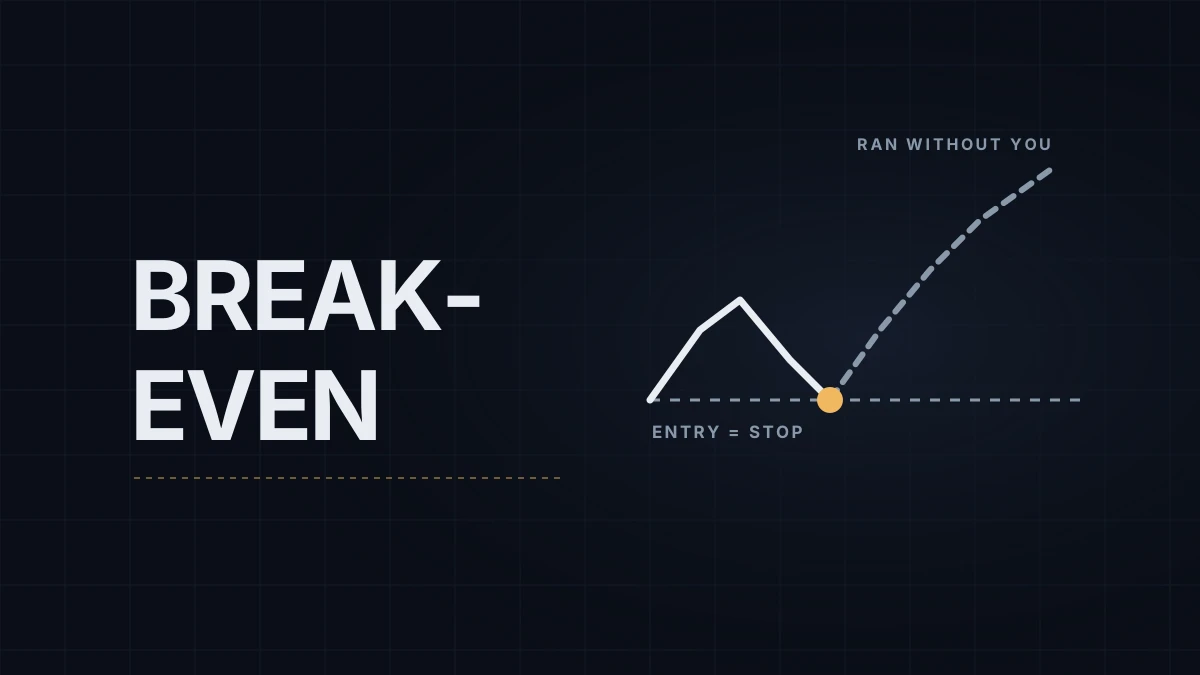
Should you move your stop to breakeven once a trade is in profit? Most traders answer from the last trade they remember: the one that came back to the entry and stopped them out for nothing, or the one that went 15 points their way and then lost the full stop. Both memories are accurate. The rule changes both kinds of trade at once, so the answer has to come from counting, not from the last session.
Moving the stop to breakeven (BE) means shifting the protective stop from its original place to the entry price, sometimes plus a tick or two to cover costs, once price has moved a set distance in your favor. That distance is the trigger. From then on the worst outcome of the trade is roughly zero instead of a full loss. If entries and stops on a chart are still new, start with how to read a price chart; where the original stop goes is covered in stop-loss placement on NQ.
Two groups of trades change
A breakeven rule only touches trades that reach the trigger, and among those it does two opposite things.
Losers that were in profit first become scratches. A trade that went +12, turned and fell to the −20 stop now exits at 0, which saves 20 points.
Winners that dip back to the entry before they run also become scratches. A trade that went +12, pulled back to the entry and then ran to +40 now exits at 0, which costs 40 points.
Every other trade is untouched. Losers that never reached the trigger still lose the full stop, and winners that never came back to the entry still win. The rule pays only if the points saved on the first group outweigh the points lost on the second, and on a market as quick as NQ, the E-mini Nasdaq-100 future, a pullback to the entry is part of a lot of trades that end up working.
Counting it from a journal
The measurement is one step past a standard MAE and MFE log. MFE, the maximum favorable excursion, tells you the best open profit a trade showed, so it answers whether the trigger was reached. For the losers that's enough, since a loser that reached the trigger crossed the entry again on its way to the stop. For the winners it isn't: whether price came back to the entry after the trigger is a question of the order of events, and that takes the bar data or the screen recording of each trade, not just the two extremes.
Here is a hypothetical journal of 100 NQ trades: 45 winners averaging +40 points and 55 losers at the full −20 stop, for an expectancy of +7 points a trade before costs. The same trades, tested with three trigger distances:
| BE trigger | Winners back at entry after the trigger | Points lost | Losers that reached the trigger first | Points saved | Net per 100 trades | Expectancy per trade |
|---|---|---|---|---|---|---|
| None | +7.0 | |||||
| +10 | 14 | −560 | 18 | +360 | −200 | +5.0 |
| +20 | 6 | −240 | 8 | +160 | −80 | +6.2 |
| +30 | 2 | −80 | 5 | +100 | +20 | +7.2 |
At +10 the rule scratches 14 winners to rescue 18 losers, and since a winner here is worth twice a loser, it costs 200 points per hundred trades. At +30 it barely touches the winners and still catches five reversals, so it pays a little. Where the crossover sits depends on the ratio of average win to average loss and on how often each group reaches the trigger: the bigger the winners relative to the stop, the more rescued losers each scratched winner has to pay for, and the further out the trigger has to be before the rule helps.
Two simplifications are built into the table. A scratched winner is assumed to have been worth the average win, and the breakeven exit fills exactly at the entry with no offset, commission or slippage. A real journal replaces both with the actual numbers, and the result can land on either side.
Variants traders use
A fixed trigger distance, as in the table, is the simplest version and the one NinjaTrader's Auto Breakeven automates, with the distance set in ticks. Others tie the move to structure: the stop goes to breakeven only after price makes a new swing high and pulls back into a higher low, so the trigger is the market confirming the move rather than a distance. Some use time, moving to breakeven if the trade hasn't reached a level within a set number of bars.
A common hybrid takes part of the position off at a first target and moves the stop on the rest to breakeven. That banks some profit before the stop moves, which changes the arithmetic above: the scratched winners are now only partly scratched. A trailing stop is the continuous version of the same idea, compared in trailing stops explained.
And some traders never move to breakeven at all. They leave the original stop where the trade idea is wrong until a trail or a target takes over, on the reasoning that the entry price is a level only they know about.
The version of this I still catch in my own recordings is moving the stop to breakeven with nothing on the chart arguing against the trade, only because it got a few points ahead and I wanted the risk gone. On review, those exits tend to be winners the market finished without me.
Educational content, not investment advice. Futures trading involves substantial risk of loss. Examples are for illustration only. Read the full Risk Disclosure.