Scaling Out vs One Exit: What Partial Profits Do to Expectancy
Taking half off at 1R and letting the rest run feels like the best of both. On 100 hypothetical trades with the same entries and stops, it never beat the best single exit. What scaling out does change (the swings, the win rate, how the trade feels) and when that's worth paying for.
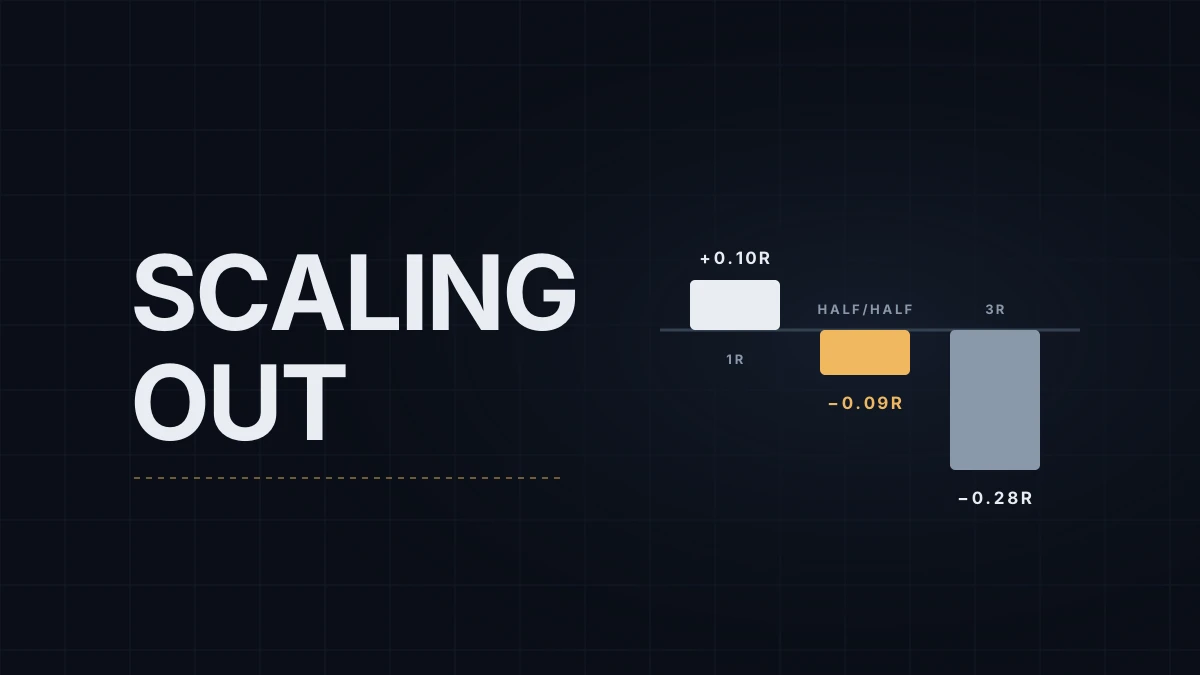
| Exit plan | Expectancy per trade | Winning trades | Breakeven trades | Swing (SD of results) |
|---|---|---|---|---|
| Everything at 1R | +0.100R | 55 | 0 | 0.99R |
| Everything at 2R | −0.100R | 30 | 0 | 1.37R |
| Everything at 3R | −0.280R | 18 | 0 | 1.54R |
| Half at 1R, half at 2R | 0.000R | 30 | 25 | 1.06R |
| Half at 1R, half at 3R | −0.090R | 18 | 37 | 1.08R |
| Thirds at 1R, 2R and 3R | −0.093R | 30 | 0 | 1.11R |
That's 100 hypothetical trades, the same entries and the same 1R stop every time, with six ways of getting out. Forty-five trades hit the stop before reaching 1R. Twenty-five reached 1R but not 2R, twelve reached 2R but not 3R, and eighteen went 3R or further. Nothing else changes between the rows. Only the exit does. (How far trades run depends on where price tends to stall, which is the level-reading skill from the price chart guide.)
Why the blended plans land in the middle
Look at the half-and-half row. Its expectancy, 0.000R, is the average of the two single exits it's made from: +0.100R at 1R and −0.100R at 2R. Half at 1R and half at 3R gives −0.090R, halfway between +0.100R and −0.280R. The thirds plan is the average of all three.
That's no coincidence. Splitting a position is the same as running two or three smaller trades with identical entries and different exits, so the result is a weighted average of those exits. It follows that scaling out can never beat the best single exit on the same set of trades. It can only land between the best and the worst.
Which single exit is best depends on how far your trades tend to run, which is the MFE distribution described in MAE and MFE explained. In this example most trades stall before 2R, so 1R wins. With a set where a third of trades run past 3R, the order flips and the far target wins. Scaling out still lands between them either way. The risk-reward guide shows why a bigger target alone doesn't improve a strategy.
What you're paying for
If scaling out can't raise expectancy, why does almost every trading educator recommend it? Look at the other columns.
The swing column is the standard deviation of results per trade. Half at 1R and half at 3R swings 1.08R, against 1.54R for the all-at-3R plan. The equity curve is smoother, and on a prop account with a trailing drawdown, smoother counts for something on its own.
The win and breakeven columns describe how the plan feels. With everything at 3R, 82 of 100 trades end at the stop. Very few traders can sit through that. Half-and-half turns 37 of those trades into scratches, and a run of scratches is far easier to live with than a run of full losses. If the smoother ride is what keeps you executing the plan, that's worth something. It just doesn't show up as expectancy.
The stop after the first exit is a separate decision
The table assumes the remaining half keeps the original stop. Most traders who scale out move it to breakeven after the first partial, and that changes the numbers: the 25 trades that reached 1R but not 2R would each end at +0.5R instead of zero. Moving the stop also cuts off trades that dip back to the entry before running, so it costs some of the 2R and 3R winners. Whether that trade-off pays is a question about your own MFE and MAE data, covered in moving the stop to breakeven and the trailing stop types post.
Test the two decisions separately. Pick the exit plan first, then decide what the stop does after the first partial. Changing both at once makes it impossible to tell which one helped.
Educational content, not investment advice. Futures trading involves substantial risk of loss. Examples are for illustration only. Read the full Risk Disclosure.