Drawdown Math: Why a 20% Loss Needs 25% to Recover, and What That Means for a Cushion
Losing and winning back are measured against different bases, so a drawdown always needs a bigger gain than the loss. Where that asymmetry is real and where it isn't, the volatility drag behind it, and how the table reads on a prop account where the cushion, not the balance, is the base.
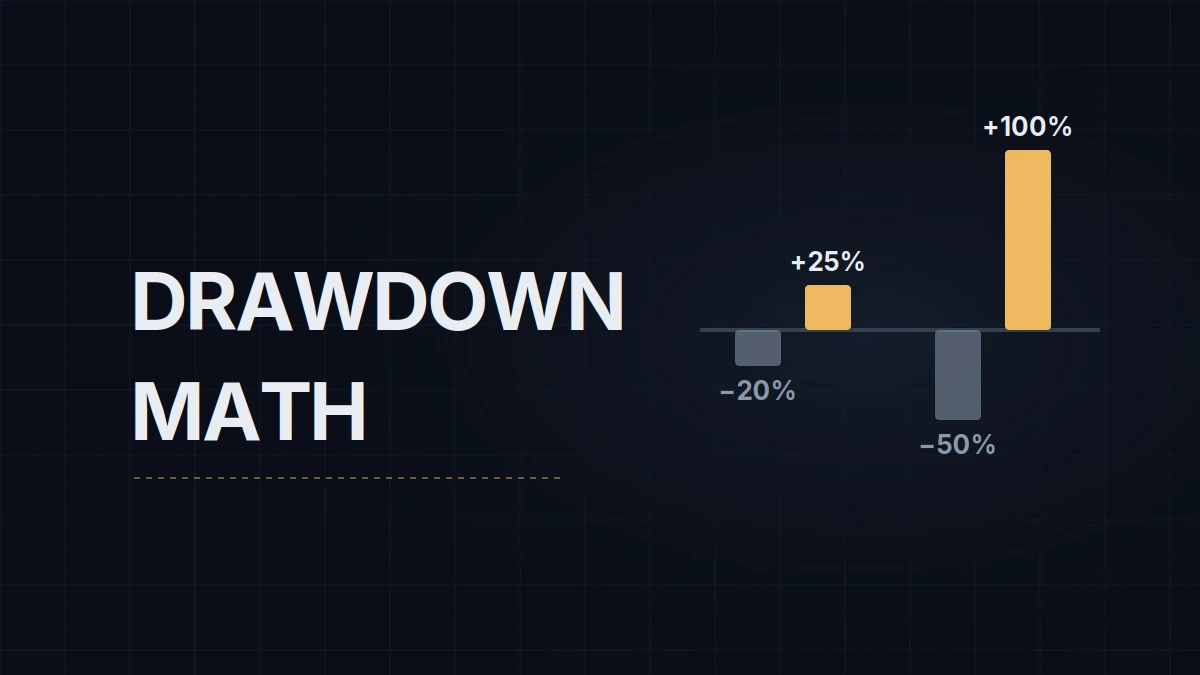
A loss L, written as a fraction (0.20 for 20%), needs a gain of L ÷ (1 − L) to get back to where it started. Lose 20% and you have 80% of the account left; 20 is a quarter of 80, so the drawdown recovery takes a 25% gain. The formula is one line, and the table below is what it produces.
Where a stop goes on the chart is a separate subject that starts with reading a price chart. This post is only the arithmetic of losing money and making it back.
The recovery table
| Loss | Left of a $50,000 account | Gain needed to get back |
|---|---|---|
| 5% | $47,500 | 5.3% |
| 10% | $45,000 | 11.1% |
| 15% | $42,500 | 17.6% |
| 20% | $40,000 | 25.0% |
| 25% | $37,500 | 33.3% |
| 30% | $35,000 | 42.9% |
| 40% | $30,000 | 66.7% |
| 50% | $25,000 | 100% |
| 60% | $20,000 | 150% |
| 75% | $12,500 | 300% |
| 90% | $5,000 | 900% |
Small losses are close to symmetric: 5% down needs 5.3% up. Past 20% the gap opens quickly, at 50% the gain has to be double the loss, and the bottom rows describe accounts that are finished for any practical purpose.
When the asymmetry is real
The table is about percentages, and a percentage is measured against whatever is left. Whether it describes your trading depends on how you size.
Trade the same size every time, one MNQ (the Micro E-mini Nasdaq-100, $2 a point) with a 40-point stop, and the table stops describing your P&L. The stop costs $80 at $50,000 and $80 at $40,000; ten losing trades cost $800 and ten winners of the same size give it back. In dollars, losing and recovering are symmetric. What shrinks is the room those same trades have left, which is a question of survival rather than arithmetic, and the subject of expectancy and risk of ruin.
Size as a share of what's left, and the table shows up in trade counts. At 10% of the account per trade it takes about 6.6 straight full losses to lose half, and about 7.3 straight wins of the same R to get it back. The ratio holds at any depth: each loss needs about 1.05 wins to undo at 5% risk per trade, 1.11 at 10% and 1.22 at 20% (the ratio is −ln(1 − f) ÷ ln(1 + f), with f the share risked).
The same compounding has a name, volatility drag, and it's why equal percentage gains and losses lose money. Up 10% and then down 10% leaves 99%. Ten such pairs leave 90.4%, a 9.6% loss from a record that looks flat. At 5% swings the same twenty trades cost 2.5%, and at 2% swings 0.4%. The drag grows with the square of the swing, which is an argument for small size that has nothing to do with the odds of ruin.
On a prop account, the base is the cushion
The percentage that matters on a prop account isn't taken from the balance. The cushion is the distance between the balance and the floor set by the max loss limit, and on a 50K account with a $2,000 max loss it starts at $2,000. A $1,000 loss is 2% of the balance and 50% of the cushion, and it's the second number that behaves like the table.
| Cushion used, of $2,000 | Gain on what's left to restore it | Fixed $200 a trade: losses of room left, wins to restore | 10% of cushion a trade: risk per trade now, wins to restore |
|---|---|---|---|
| $250 | 14% | 8.75 losses, 1.25 wins | $175, 1.4 wins |
| $500 | 33% | 7.5 losses, 2.5 wins | $150, 3.0 wins |
| $1,000 | 100% | 5 losses, 5 wins | $100, 7.3 wins |
| $1,500 | 300% | 2.5 losses, 7.5 wins | $50, 14.5 wins |
Wins and losses are the same size in R; commissions left out.
The two ways of sizing fail in opposite directions. Fixed size recovers fastest, five wins for five losses, while the room shrinks: with $500 of cushion and $200 at risk per trade, two and a half losses end the account, which is one ordinary losing streak. Sizing from the cushion keeps the room at ten trades of the current size and pays for it in time: from three-quarters down, recovery takes about 14.5 wins against 7.5. In practice the smallest contract puts a floor under the second method. At $500 of cushion, 10% is $50, less than a 40-point stop on one MNQ costs ($80), so the smallest possible size already risks 16% of what's left. A common compromise is a step: full size above one cushion level, reduced size below it.
The trailing floor caps the cushion
A trailing drawdown adds one more rule. Before it locks, the cushion at each close can't exceed the max loss: each new peak, measured the way the firm measures it (at the day's close on an end-of-day account), moves the floor up by the same amount, so the cushion stays at $2,000 however good the week was. Recovering below the previous peak does restore the cushion dollar for dollar, which is the only stretch where winning trades buy room. The cap lifts when the floor locks. On a LucidFlex 50K at the time of writing, the floor stops at $50,100 once the end-of-day balance passes $52,100, and from then on profit adds to the cushion as it would on any account. How each firm trails and locks is in trailing drawdown explained.
So the prop version of the recovery table has a ceiling. A bad day moves you down the rows, and good days move you back up only as far as the top row until the lock. A daily loss limit caps how far down one session can take you: at $500 on a $2,000 cushion, no single day costs more than a quarter of the full cushion, give or take the slippage on the exit.
My own base size is one MNQ, and on a cushion of $2,000 or less that's all I trade, which puts me in the fixed-size column: each loss takes one win of the same size to undo. Above that, size grows only with the cushion, by at most one more MNQ for every $2,000 to $3,000 of it, and it comes back to one as the cushion shrinks. It's the step from the section above, with the smallest contract as the floor it steps down to.
Educational content, not investment advice. Futures trading involves substantial risk of loss. Examples are for illustration only. Read the full Risk Disclosure.