Trailing Stops Explained: Fixed, ATR, Structure-Based and Time-Based Trails
A trailing stop decides how much of a winning move you keep. The same hypothetical NQ trade run through four common trails, fixed distance, ATR, structure and a three-bar low, with the points each kept and gave back, and the trade-off between giving back profit and getting shaken out by noise.
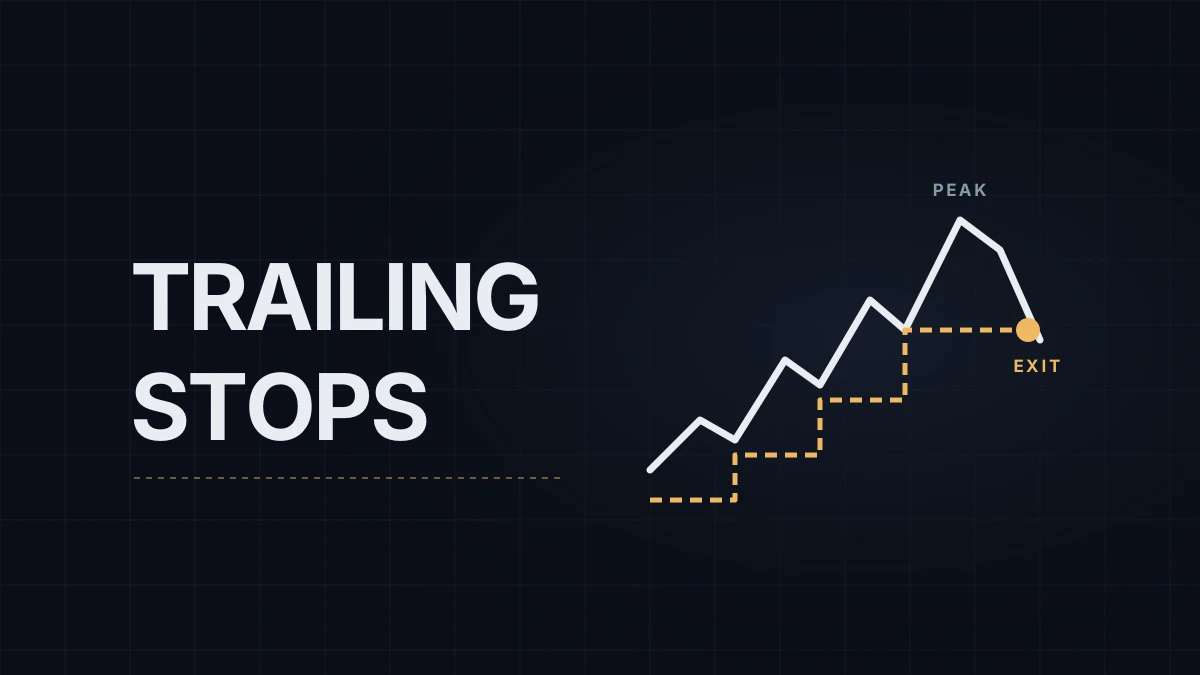
A trailing stop is a stop that moves only in the direction of the trade: up behind a long, down above a short, never back. Its job starts after the entry, once the initial stop has done its part, and it decides how much of a winning move you keep. Every version trades off the same two costs: profit handed back between the peak and the exit, and good trades closed early by ordinary noise.
The examples use NQ, the E-mini Nasdaq-100 future, quoted in points; if reading the bars themselves is new, start with how to read a price chart. The initial stop is a separate decision, covered in stop-loss placement on NQ, and this post assumes it's already in place: 20 points below entry.
One trade, four trails
Here is a hypothetical long on 5-minute bars, in points from the entry. Price rises to +36 within three bars, pulls back to +14, climbs to +64, dips to +38, runs to +96, and then slides back through +64, +52 and +40 before a last bar down to +30. The maximum favorable excursion (MFE), the best open profit the trade ever showed, is 96 points.
| Trail | Rule | Exit | Points kept | Given back from +96 |
|---|---|---|---|---|
| Fixed distance | 20 points below the highest high | Bar 4, at +16 | 16 | 80 (20 from the +36 high at the time) |
| ATR | 2 × ATR, 30 points with an ATR of 15, below the highest high | Bar 11, at +66 | 66 | 30 |
| Structure | 2 points under the last higher swing low | Bar 14, at +36 | 36 | 60 |
| Time-based | Lowest low of the last three completed bars | Bar 13, at +52 | 52 | 44 |
On this path the ATR trail kept the most, but the ranking belongs to the path, not to the method. A trade that runs straight up without a deep pullback would favor the fixed trail; one that trends in wide swings for an hour would favor structure.
Fixed distance
The stop sits a set number of points or ticks behind the best price since entry. It's the simplest trail to automate, and platforms build it in: NinjaTrader's Auto Trail in an ATM strategy, described in the NinjaTrader 8 ATM strategy guide, is a fixed trail in steps. The weakness is that the distance doesn't know the market's mood. Twenty points was enough room on a quiet stretch and too little for the first pullback here, which reached 22 points from the high and took the trade out at +16, well before the real move.
ATR
The average true range (ATR) measures how far the bars have been moving on average, and an ATR trail sets the distance as a multiple of it, so the stop widens on volatile days and tightens on quiet ones. Hung from the highest high, it's often called a chandelier stop. With an ATR of 15 and a multiple of 2, the stop sat 30 points behind the high, survived both pullbacks and gave back exactly 30 points at the end. The cost is that the trail always gives back at least a full multiple of ATR from the peak, by design. NQ average daily range covers how ATR behaves on this contract.
Structure
The stop moves only when the market prints a new higher swing low and then breaks above the previous high, and it goes just under that swing low. It follows the trade's own shape instead of a number. In this example it moved twice, to +12 and then to +36, and never again, because after the +96 high no new swing low was confirmed before the slide. Structure trails ride staircase trends well and hand back a lot when a move ends in a straight drop.
Time-based
The stop follows the lowest low of the last few bars, here three, so it moves with the clock as much as with price; each new bar can drag it up even if price only drifts. It exited at +52 when the thirteenth bar broke the low of the previous three. A related version is a plain time exit: close the trade at a set time, or after a set number of bars if it hasn't reached a level. The cost of a bar-count trail is that slow, choppy trends keep tightening it until a routine dip ends the trade.
Choosing the distance
None of the four is right in general. What decides is how far your winners usually pull back before they continue, and that's measurable. How far winning trades pull back from their running high before continuing shows how much room a trail needs. The maximum adverse excursion (MAE), how far a trade went against the entry, does the same job for the initial stop, and MFE shows how far good trades tend to run. A trail tighter than the typical pullback of winners turns them into small scratches; a trail much wider than it gives back profit for no benefit. MAE and MFE explained shows how to collect these numbers from a journal.
My exits start from a target of at least 35 points; when the move has momentum, the ATM's trailing stop takes over before the target is reached, and on range days the fixed target usually does the work.
Educational content, not investment advice. Futures trading involves substantial risk of loss. Examples are for illustration only. Read the full Risk Disclosure.