Apex Trader Funding 4.0 Explained: EOD vs Intraday Trail, the Payout Ladder and What Changed
On March 1, 2026 Apex Trader Funding replaced its evaluations with Apex 4.0. The EOD and intraday evaluations side by side, the tiered contract and loss limits on the performance account, the six-step payout ladder, what changed from the Legacy accounts, and the conduct rules for all of them.
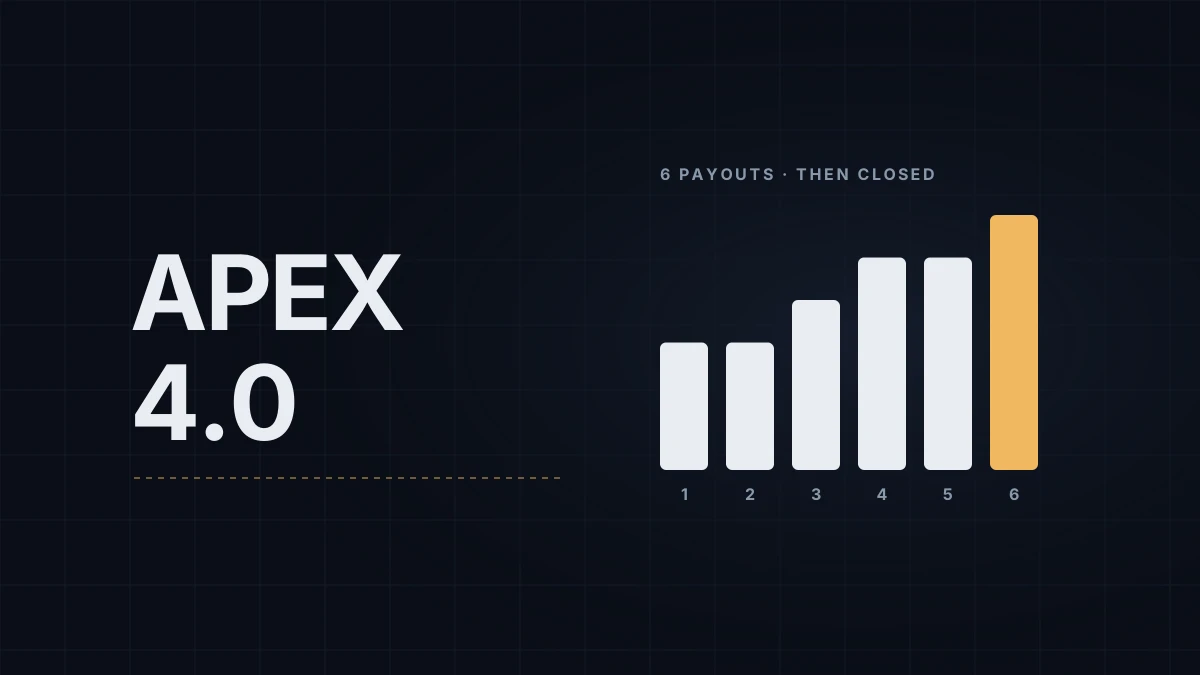
On March 1, 2026 Apex Trader Funding replaced its evaluations with a new set it calls Apex 4.0. Accounts bought before then became Legacy accounts and keep their old rules as long as their billing isn't interrupted. Apex now sells two evaluation types: end-of-day (EOD), where the drawdown floor is recalculated once a day from the closing balance, and intraday, where it follows the highest balance in real time, open profit included. Both lead to a performance account (PA), Apex's simulated funded account, with the same drawdown type. How evaluations work in general is in prop firm evaluations explained, and the two drawdown types in trailing drawdown explained. Everything below is from Apex's help center at the time of writing, except where a third-party source is named.
The evaluation
| 25K | 50K | 100K | 150K | |
|---|---|---|---|---|
| Profit target | $1,500 | $3,000 | $6,000 | $9,000 |
| Trailing drawdown, EOD or intraday | $1,000 | $2,000 | $3,000 | $4,000 |
| Daily loss limit, EOD only | $500 | $1,000 | $1,500 | $2,000 |
| Maximum contracts | 4 | 6 | 8 | 12 |
Both types run for 30 days of access with no minimum number of trading days, no consistency rule and no scaling, and a passing trader has 7 days to activate the PA. Evaluations are a one-time purchase rather than a subscription, followed by an activation fee for the PA, or a higher-priced No Activation Fee version that skips it; prices are shown at checkout and discount codes run often.
On the EOD evaluation the floor is recalculated at 4:59:59 PM ET from the closing balance and enforced in real time the next day: touch it at any moment and the evaluation fails. The daily loss limit counts open losses, and hitting it flattens positions and pauses trading for the session without failing the account. The intraday evaluation has no daily loss limit, but its floor moves up with every new high in open profit, which is what makes a give-back from the top expensive there.
The performance account
The PA keeps the evaluation's drawdown amount and type. The floor stops trailing at the starting balance plus $100: on a 50K, $50,100, reached once the highest balance is $52,100. Size and the daily loss limit then grow in tiers based on profit, set from the prior day's close at 4:59:59 PM ET and fixed for the whole next session:
| 50K PA, profit since start | Maximum contracts | Daily loss limit |
|---|---|---|
| $0 to $1,499 | 2 | $1,000 |
| $1,500 to $2,999 | 3 | $1,000 |
| $3,000 to $5,999 | 4 | $2,000 |
| $6,000 and up | 4 | $3,000 |
The other sizes follow the same pattern, topping out at 2, 6 and 10 contracts on the 25K, 100K and 150K. Ten micros count as one contract, and the limit covers all open positions combined; an order that would exceed it is rejected without penalty. A PA has to record at least 2 days of $50 or more in net profit in every rolling 30 days, or it's closed for inactivity.
The payout ladder
A payout request needs 5 trading days that each made at least the minimum ($250 on a 50K EOD, $200 on a 50K intraday), no single day at 50% or more of the profit since the last payout, and a balance above the safety net plus the $500 minimum request: $52,600 on a 50K. The safety net, the drawdown plus $100 above the starting balance, stays for the life of the account. Approved payouts are paid 100% to the trader. After the sixth payout the PA closes.
| Payout | 50K EOD | 50K intraday |
|---|---|---|
| 1 | $1,500 | $1,500 |
| 2 | $1,500 | $2,000 |
| 3 | $2,000 | $2,500 |
| 4 | $2,500 | $2,500 |
| 5 | $2,500 | $3,000 |
| 6 | $3,000 | $3,000 |
| Total | $13,000 | $14,500 |
The ladder makes a PA a finite asset: at most $6,000 on a 25K, $18,000 or $18,500 on a 100K, and $20,500 or $21,500 on a 150K. Why caps like these matter when comparing firms is in prop firm payout caps; the 50% rule next to other firms' versions is in the prop firm consistency rule.
What changed from Legacy
Legacy evaluations are still sold from time to time as limited offers, so both versions are in circulation. On a 50K:
| Legacy | Apex 4.0 | |
|---|---|---|
| Evaluation pricing | Monthly subscription | One-time purchase, 30 days of access |
| Trailing drawdown | $2,500 | $2,000 |
| Maximum contracts in the evaluation | 10 | 6 |
| Daily loss limit | None | $1,000 on the EOD evaluation; tiered on the PA |
| Drawdown types | Intraday trailing | EOD or intraday, chosen at purchase |
| Payout consistency | 30% | 50% |
The Legacy column for pricing, drawdown, contracts and the daily limit comes from Apex's current Legacy product page. The 30% figure comes from Apex's Legacy PA payout rules. Apex's Legacy PA trading rules also keep an open-loss rule capping a trade's unrealized loss at 30% of the day's starting profit balance; it applies to Legacy PAs only and isn't on the general list of prohibited activities.
Rules for every account
Apex's prohibited activities apply to all of it. Every trade needs a pending or mental stop loss, and using the account's drawdown threshold as the stop is prohibited, as is a strategy with a tiny target against a huge stop; Apex's own example is a 5-tick target with a 150-tick stop. Hedging, holding long and short at the same time on the same or a correlated instrument, is banned, including across accounts. News trading is allowed as part of a normal strategy, but brackets on both sides of a release to catch the move are not. Automated trading isn't allowed, positions have to be closed before the market close, and VPNs or cloud servers used to disguise a trader's location are prohibited. The general list across firms is in prohibited trading practices at prop firms.
Educational content, not investment advice. Futures trading involves substantial risk of loss. Examples are for illustration only. Read the full Risk Disclosure.