Payout Caps and Payout Ladders: How Much a Funded Account Can Pay Before It Ends
A payout cap limits one withdrawal; a payout ladder limits the account's whole life. Apex's six-step ladder, Topstep's 50% rule with no fixed end, Lucid's five-payout plans, what each 50K can pay in total, and the profit that has to stay behind.
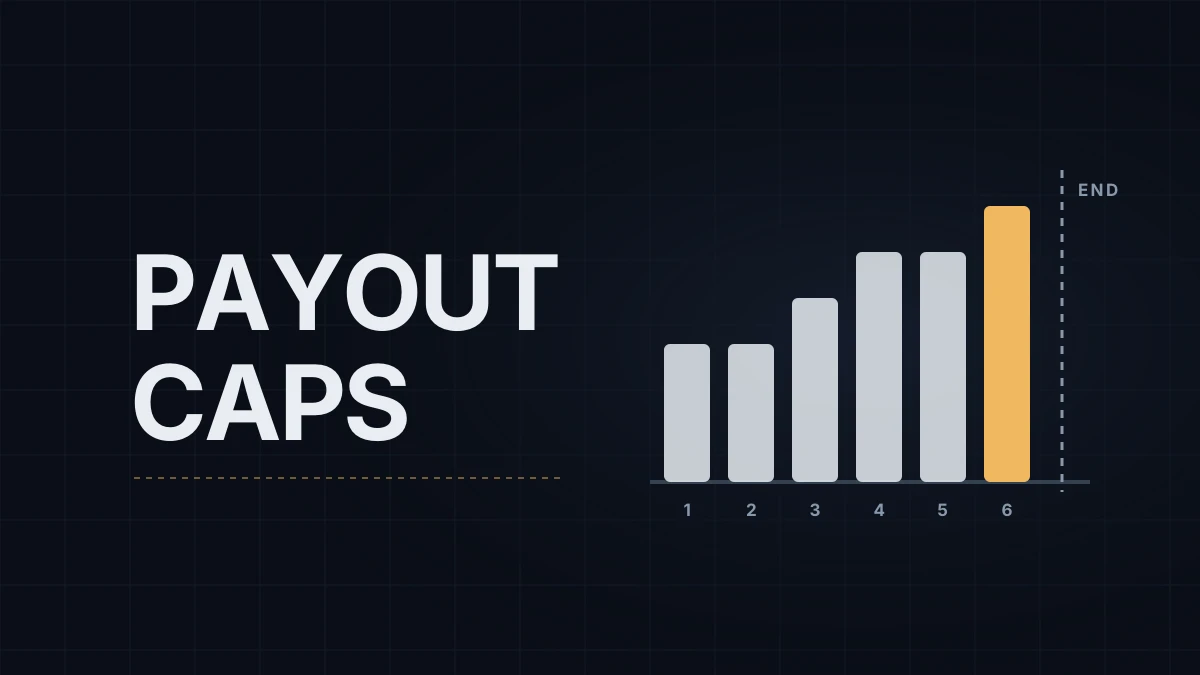
A payout cap is the most a funded account lets you withdraw in one request. A payout ladder is a fixed schedule of those caps, one step per payout, and when the schedule runs out the account ends or moves on. The cap sets how fast money can leave a funded account; the ladder sets how much can ever leave it. On a 50K account at the time of writing that ceiling runs from $10,000 at Lucid to $14,500 at Apex, and Topstep sets no fixed total at all.
If funded accounts are new to you, the pillar explains the model. Payout rules covers buffers, splits and qualifying days in general; this post is only about the limits.
Apex: six steps, then a new evaluation
Apex Trader Funding publishes one ladder per drawdown type. For the end-of-day and intraday accounts Apex has sold since March 1, 2026, the 50K steps are:
| Payout | 50K end-of-day drawdown | 50K intraday drawdown |
|---|---|---|
| 1 | $1,500 | $1,500 |
| 2 | $1,500 | $2,000 |
| 3 | $2,000 | $2,500 |
| 4 | $2,500 | $2,500 |
| 5 | $2,500 | $3,000 |
| 6 | $3,000 | $3,000 |
| Total | $13,000 | $14,500 |
After the sixth payout Apex closes the performance account, and another one takes another passed evaluation. Apex pays 100% of approved payouts on these accounts, so the totals are also what reaches the trader. Each request needs five qualifying days (at least $250 of profit each on a 50K end-of-day account, $200 on intraday), no single day making up 50% or more of the profit since the last payout, and a balance of at least $52,600: the $52,100 safety net stays in the account for its whole life, and the minimum request is $500. Taking the full $13,000 therefore takes at least $15,100 of profit, and the last $2,100 never leaves. Apex's Legacy accounts, back on sale for a limited time at the time of writing, are a separate program with their own payout rules.
Topstep: a cap per request and no ladder
Topstep's Express Funded Account (XFA) has no fixed number of payouts. Each request is capped at 50% of the account balance, and on a 50K at $2,000 under the Standard path (five winning days of $150 or more) or $3,000 under the Consistency path (three trading days, with the largest day no more than 40% of net profit). Under an offer running since June 2, 2026, Combines bought with a daily loss limit added at checkout get double those caps. The split is 90/10.
The XFA balance starts at $0, with the maximum loss limit at −$2,000 on a 50K, and after the first payout the limit moves up to $0. So taking $2,000 requires a $4,000 balance under the 50% rule, and afterward the $2,000 left in the account is the entire cushion. There is no ladder to run out: the account ends when the balance reaches the limit, or when Topstep's risk team moves the trader to a live account. That move is Topstep's decision and closes every XFA the trader holds. Balances carry over only up to the live account's size and the rest is forfeited; 20% of what carries over can be traded at once, and 80% sits in a reserve that unlocks in stages. Live payouts have no dollar cap, but each request is limited to 50% of the balance until the trader has 30 winning days in the live account, and they come only from the unlocked balance. Traders in countries where Topstep offers funded but not live accounts can take up to $200,000 in total.
Lucid: five payouts, then a review
Lucid Trading's plans stop at payout five. On a 50K, LucidFlex pays up to half the profit, at most $2,000 per request; LucidPro pays up to $2,000 the first time and $2,500 after; LucidDirect pays $2,000 for payouts one to three and $2,500 for four and five. After the fifth payout the trader enters Lucid's live review, and whether the account moves live is up to Lucid's risk team. LucidDaily works differently: no cap per request and no payout count, but a day that reaches $8,000 of profit on a 50K triggers the live review. All four split 90/10. Lucid account types compares the four plans rule by rule.
The ceiling on a 50K
| Plan (50K) | Payouts before the account ends or is reviewed | Most you can withdraw | To the trader after the split |
|---|---|---|---|
| Apex, end-of-day | 6 | $13,000 | $13,000 |
| Apex, intraday | 6 | $14,500 | $14,500 |
| LucidPro | 5 | $12,000 | $10,800 |
| LucidDirect | 5 | $11,000 | $9,900 |
| LucidFlex | 5 | $10,000 | $9,000 |
| Topstep XFA | No fixed number | $2,000 or $3,000 per request, no total | 90% |
| LucidDaily | No fixed number | No cap per request | 90% |
The ceiling assumes every payout is taken at its cap, and getting there takes more profit than the total. Apex keeps $2,100 in the account. LucidFlex's half-the-profit rule means the first $2,000 needs $4,000 of profit behind it. Tradeify's Select Flex plan, for comparison, caps each payout at $2,500 on 50K accounts bought after September 1, 2026, and makes the trader eligible for live consideration after three payouts on one account.
Why firms cap payouts
A cap turns one large week into several payout cycles, each with its own qualifying days and consistency check. That slows down how quickly simulated profit becomes cash, spreads it over more trading days, and gives the firm time to see whether the profit came from a repeatable process or one lucky stretch. A ladder that ends with a closed account brings the trader back to the evaluation, which is where firms earn most of their revenue; how prop firms make money shows that side of the ledger. A ladder that ends in a live review is the firm deciding whether to put its own capital behind the trader.
None of this makes a capped account a bad deal. It changes how to value one: by the payouts it has left at its cap, not by its balance. Most funded accounts never get near the end of the ladder. Of the firms that publish figures, between 28.5% and 39.2% of funded traders got even one payout, as covered in prop firm pass rates, and passing the evaluation and failing the funded account explains where the rest go.
I trade LucidFlex, so the two numbers I plan around are the cap on each request and the review after payout five, not the balance on the dashboard.
Educational content, not investment advice. Futures trading involves substantial risk of loss. Examples are for illustration only. Read the full Risk Disclosure.