The Evaluation Is Not the Strategy: Why Traders Change Their Method to Pass and What It Costs
The usual advice on passing a prop firm evaluation is to trade differently until it's over: bigger size, more trades, a looser stop. Each change creates a strategy with no track record. What a simulation says about size and pass rates, and two ways to pass with the method you already tested.
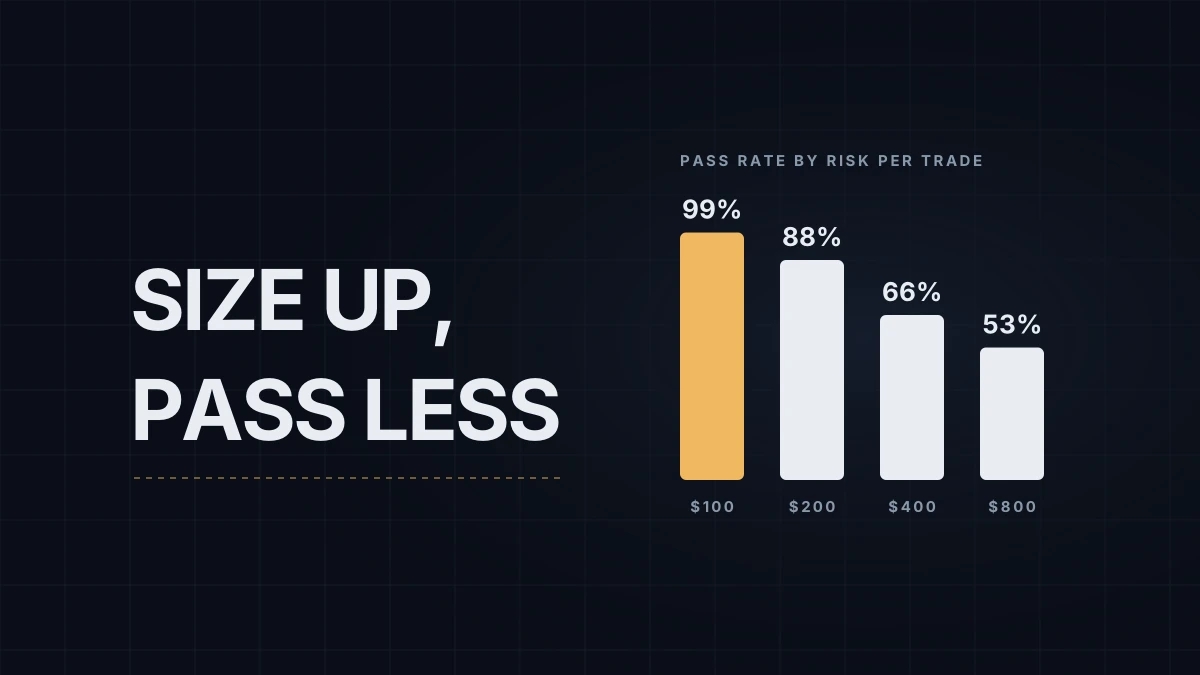
A trader whose method makes a few hundred dollars on a good day buys a 50K evaluation with a $3,000 target and decides to be done in a week. So for that week they trade twice their usual size, take the B setups they normally skip, and give the stop a little more room in case a good trade needs it. Each of those changes is reasonable on its own. Together they produce a strategy the trader has never tested, run on an account that ends after one bad day. That's the honest answer to "how to pass a prop firm evaluation": the method that passes most often is usually the one you already have, traded the way you tested it. How evaluations work is in the pillar.
The size question has a clear answer, and it surprises people. I simulated a strategy with a modest real edge, winning half its trades and making 1.5 times on a winner what it loses on a loser before costs, on a 50K evaluation with a $3,000 target and a $2,000 drawdown that trails the highest balance. Risking $100 a trade, it passed 99% of the time, after a median of 110 trades. Risking $200, it passed 88% of the time in 47 trades; at $400, 66% in 15 trades; at $800, 53% in 6. Every step up in size made the evaluation faster and the pass less likely, because a larger bet gives the edge fewer trades to show up before a normal losing streak reaches the floor. A run of five losses in a row happens in about 81% of 100-trade samples at a 50% win rate. At $200 a trade that's $1,000 of a $2,000 drawdown; at $400 it's all of it.
Run the same simulation on a strategy with no edge, winning half its trades at 1 to 1 and paying $5 a trade in costs, and the pattern flips: 3% pass at $100 a trade, 17% at $200, 24% at $400 and 32% at $800. Across these sizes, bigger was better for a strategy with no edge, which is why the advice to size up circulates: it works often enough to produce stories, for the people it works for. The same account, funded, then meets the same missing edge at the same size, which is the usual path in passing an evaluation and failing the funded account.
The other changes are harder to put numbers on, and that's the problem with them. A B setup taken because the target is close has no win rate you know. A wider stop changes the loss size the expectancy was built on, and a stop moved after entry turns a planned loss into an unplanned one. A strategy's statistics belong to the exact rules that produced them; how many trades it takes to judge a setup shows how much data even an unchanged method needs before its numbers mean much.
There are two ways through that keep the tested method intact. The first is the obvious one: trade the evaluation exactly as the strategy is traded, at a size where a normal losing streak fits comfortably inside the drawdown, and accept that it takes weeks rather than days. Position sizing for futures covers how to set that size from the stop. The cost of the slower route is the fee structure: an evaluation bought once with no time limit costs nothing extra for taking longer, while a monthly subscription charges for every extra month, so the slow route favors one-time evaluations.
The second is to make the faster style its own strategy, with its own rules and its own test, and run it on a separate evaluation. If a quicker version of the setup holds up over a real sample in Market Replay or on a simulator, it's a second method rather than an improvised one, and an evaluation that fails tells you something about that method instead of about a week of improvisation. Either way, a reset bought to try the same improvisation again is the expensive option; when to reset a prop evaluation goes through that decision.
The evaluation asks one question: can this method make $3,000 before it loses $2,000 under these rules. Changing the method to answer it means the firm is testing something you haven't.
Educational content, not investment advice. Futures trading involves substantial risk of loss. Examples are for illustration only. Read the full Risk Disclosure.