MNQ or NQ on a Prop Account: Contract Limits, Tick Value and Drawdown Granularity
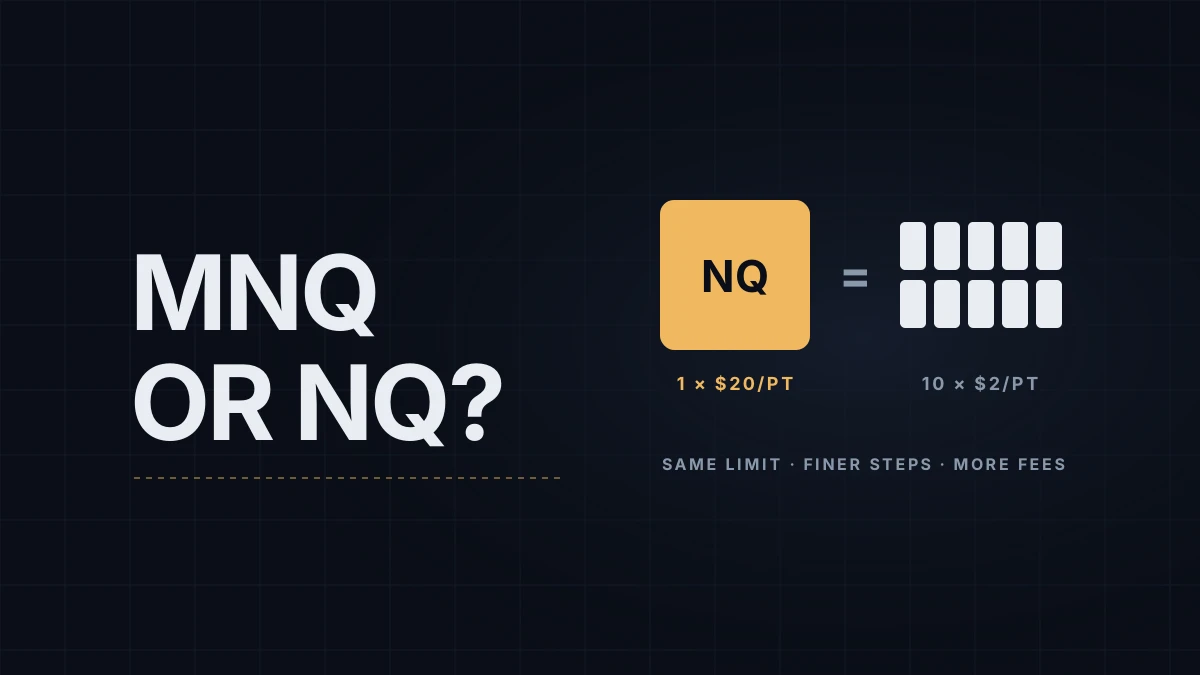
Ten MNQ move like one NQ, and the four firms here count them that way. The difference is in the steps: how finely you can size risk against a drawdown, what the extra round turns cost, and the rules that treat the two contracts differently. Numbers from Lucid, Apex, Topstep and Tradeify.
On a 50K evaluation with a $2,000 drawdown, a 30-point stop on one NQ costs $600, 30% of everything the account can lose. On MNQ the same stop costs $60 per contract, so the trader can risk 3%, 6%, 15% or any step in between. That difference in granularity, more than the contract limit, is what separates the two on a prop account.
NQ is the E-mini Nasdaq-100 future at $20 a point; MNQ, the Micro E-mini, is a tenth of it at $2 a point, with a tick of 0.25 points worth $5.00 and $0.50 respectively. NQ vs MNQ tick and point value covers the contracts, and prop firm evaluations explained covers the account.
How firms count micros
At the time of writing, Lucid, Apex Trader Funding, Topstep and Tradeify all count ten micros as one mini on evaluations, and all four state the same for their simulated funded accounts, Apex for its Performance Accounts. A 50K limit of 4 contracts on LucidFlex means 4 NQ or 40 MNQ, or any mix in between, such as 2 NQ and 20 MNQ. Scaling plans are written in minis too: a funded account that starts at 2 contracts starts at 20 micros, and a micro trader can climb inside that limit one contract at a time.
Two exceptions at Topstep matter for Nasdaq traders. Its Live Funded Account doesn't offer the 10:1 ratio. And during its Tier 1 news windows, 10 minutes around CPI, the FOMC decision and press conference, the jobs report and PPI, new NQ positions can't be opened at all, while new MNQ positions are allowed up to a cap that depends on the account (3 micros on a 50K Trading Combine, for example). Existing positions can be kept through the window.
Risk in steps
With the 30-point stop from the opening, on a $2,000 drawdown:
| Position | Risk at the stop | Share of the drawdown |
|---|---|---|
| 1 MNQ | $60 | 3% |
| 2 MNQ | $120 | 6% |
| 3 MNQ | $180 | 9% |
| 5 MNQ | $300 | 15% |
| 10 MNQ or 1 NQ | $600 | 30% |
| 2 NQ | $1,200 | 60% |
On NQ the only realistic choices are 30% and 60%. Measured in ticks, a $2,000 drawdown is 400 ticks on one NQ and 4,000 ticks on one MNQ, which is why micros let a trader keep the stop where the setup puts it and adjust the size instead. On a trailing drawdown that matters twice, because the room also shrinks as an open winner is given back; trailing drawdown explained shows how.
What the extra round turns cost
The same exposure costs more in fees on micros, because each contract pays its own commission and exchange fee. Round-turn costs for 1 NQ against 10 MNQ, at the time of writing:
| Firm, platform | 1 NQ | 10 MNQ | Ratio |
|---|---|---|---|
| Lucid | $3.50 | $10.00 | 2.9× |
| Apex, Tradovate | $3.10 | $10.40 | 3.4× |
| Apex, Rithmic | $3.98 | $10.20 | 2.6× |
| Topstep, TopstepX | $3.78 | $12.20 | 3.2× |
| Tradeify | $5.76 | $18.20 | 3.2× |
Topstep's and Tradeify's figures are all-in; Lucid and Apex list commissions without saying whether exchange fees are included. At Lucid's rates the gap is $6.50 per trade, about a third of an NQ point. Over 100 full-size trades that's $650, a third of a 50K drawdown. The difference only applies in blocks of ten micros; from one to nine MNQ there's no NQ alternative to compare against. MNQ commissions and futures trading fees breaks the fees into their parts.
Holding both
Same-direction NQ and MNQ positions are allowed everywhere in this list. Opposite positions are where firms differ: Lucid permits long NQ against short MNQ inside one account but not across accounts, Tradeify treats it as a hedge within one account or across several, Apex prohibits long and short positions on the same or a correlated instrument, and Topstep prohibits it across accounts without addressing a single account. For partial exits, some traders hold a small NQ core plus micros, so that part of the position can come off in finer pieces.
Choosing
- Micros only. The finest risk steps and the lowest cost per trade at small size. The cost is roughly three times the fees per unit of exposure, 2.6× to 3.4× in the table, once the position reaches ten contracts.
- Minis only. The cheapest fees for the exposure. The cost is risk in 30% steps against a 50K drawdown, which means a fixed and narrow stop or an oversized position.
- Micros until the cushion supports a mini. Trade MNQ while the room above the floor is small, and switch to NQ when one NQ at the setup's normal stop is a small share of that room. The cost is two sets of habits and a step change in fees when the switch happens.
I trade the micro on Lucid: one contract to start, adding only as the cushion above the floor grows.
Educational content, not investment advice. Futures trading involves substantial risk of loss. Examples are for illustration only. Read the full Risk Disclosure.