Scaling Plans and Max Position Size on Prop Accounts: How the Rules Work and How to Size Under Them
The contract cap on the pricing page is the ceiling, not the size. Funded accounts open below it and climb as profit builds, payouts pull the tier back down, and the cap never moves mid-session. How the ladders work at Lucid and Topstep, and a method for choosing size from the cushion.
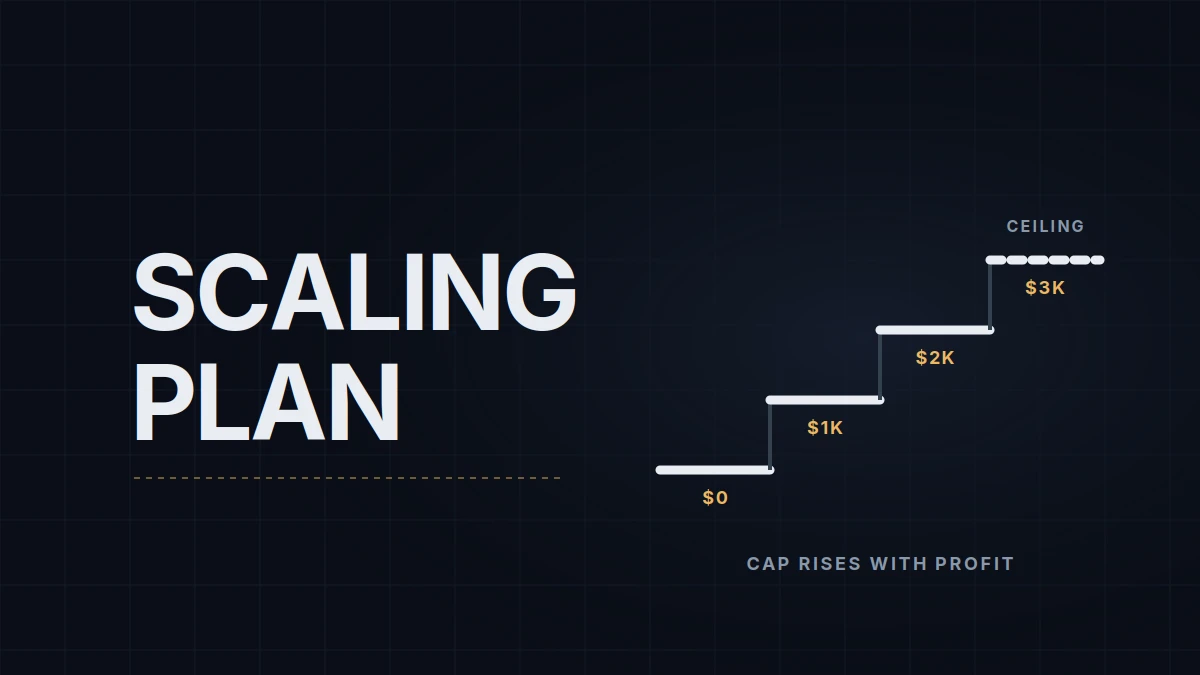
A 50K evaluation is sold with a 4-mini cap and passed with a 4-mini cap, and the funded account that follows it opens at 2. That is not a mistake in the dashboard; it is the scaling plan, the clause that ties the size you may trade to the simulated profit you have made, and it is the clause most traders meet for the first time on the morning they try to place the order that passed the evaluation. What follows is how the plans work at two firms, the four mechanics that catch people, and a way to choose size that treats the cap as what it is: a ceiling, not a recommendation.
Two ladders
Lucid publishes the LucidFlex funded ladder as a table, and it is the clearest example of the form. There is no scaling in the evaluation; the funded account opens at the bottom rung and climbs by simulated profit.
| Simulated profit | 25K | 50K | 100K | 150K |
|---|---|---|---|---|
| $0 to $999 | 1 mini / 10 micros | 2 / 20 | 3 / 30 | 4 / 40 |
| $1,000 to $1,999 | 2 / 20 | 3 / 30 | 4 / 40 | 5 / 50 |
| $2,000 to $2,999 | 4 / 40 | 5 / 50 | 6 / 60 | |
| $3,000 to $4,499 | 6 / 60 | 8 / 80 | ||
| $4,500 and above | 10 / 100 |
Topstep's version applies to the Express Funded Account, which starts at a $0 balance, so the ladder begins at the bottom by construction; a 50K account at the time of writing opens at 2 minis and reaches its full 5 above $2,000 of balance. The Trading Combine that precedes it has no ladder, only a fixed cap of 5, 10 or 15 minis by size. Apex works the other way around: the evaluation has the higher cap and the Performance Account opens at half its maximum until the trailing threshold is cleared.
Three firms, one shape. The size you were sold is the top rung; the size you get is the bottom one; and what moves you between them is profit that has not been paid out.
Four mechanics that catch people
It updates at the end of the session. Both Lucid and Topstep recalculate the tier from the closing balance, and neither raises it mid-session. Cross $1,000 of profit at 11:00 and the third contract is available tomorrow, not now. The reverse is usually also true: a losing morning does not shrink the cap until the close, which is not the favor it looks like.
A payout pulls the tier down. Simulated profit is the balance above the starting balance; a payout reduces it; the tier follows. A 50K LucidFlex account at $2,400 of profit trades 4 minis; take a $1,500 payout and it trades 2 the next session. The account has not lost anything, but the size it can hold has halved, and any copier follower on that account is capped with it while the leader trades on.
Micros count at ten to one, and some products don't. A 2-mini rung is 2 minis, 20 micros, or one of each plus ten. Topstep weights a few products differently and, during high-volatility periods, sets lower ceilings on named products and blocks new mini entries on the equity indexes in the minutes around a CPI release. The ladder is the ceiling only when no other clause is lower.
Exceeding it is not always a breach, and never free. Topstep ignores an overage corrected within ten seconds and reviews the ones that last longer. Lucid's platforms block the order where they can, and repeated attempts to work around the limit can cost the day's profit. On either, the cap is enforced against net exposure, so an extra contract left on by a partial fill or a doubled click counts.
The cap is not the size
The ladder answers "how many may I hold". The question that matters is "how many should I hold", and its answer comes from a different number: the cushion, the distance between the current balance and the loss limit. On a fresh 50K LucidFlex funded account that distance is $2,000; on a Topstep Express Funded Account after its first payout it is whatever balance remains above zero. The cushion is the capital on a prop account, and size belongs to capital.
The method has three inputs and one division. Decide the fraction of the cushion one losing trade may cost; a fifth is aggressive, a tenth is conservative, and the number is a policy, not a calculation. Take the stop for the trade in front of you, in points, from the setup and the day's range, and convert it to dollars per contract. Divide.
| Cushion | Risk per trade at one fifth | MNQ contracts, 40-point stop ($80) | MNQ contracts, 60-point stop ($120) | LucidFlex 50K ladder allows |
|---|---|---|---|---|
| $500 | $100 | 1 | 0 | 20 micros |
| $1,000 | $200 | 2 | 1 | 20 micros |
| $2,000 | $400 | 5 | 3 | 20 micros |
| $3,000 | $600 | 7 | 5 | 30 micros |
| $4,500 | $900 | 11 | 7 | 40 micros |
Two things stand out. The ladder never binds a micro trader who sizes from the cushion; the constraint that matters is on the left of the table, not the right. And the zero in the second column is a real answer: on a day when the structural stop is 60 points and the cushion is $500, the trade is not available at any size, and the method said so before the order went in.
Fixed size or cushion-based
Fixed size. Choose one contract count from the worst cushion you are willing to trade at, and trade it every day until the account is in a different regime. On the 50K example above, a trader who will not trade below a $1,000 cushion runs 1 or 2 micros and does not revisit it. The cost is the growth left on the table: at $3,000 of cushion the account could carry three times the size and doesn't. The benefit is that size stops being a decision, and on an account with a consistency rule that is worth more than it sounds, because fixed size produces days of similar magnitude by construction.
Cushion-based. Recompute the size from the table each session, from the closing cushion, the way the ladder recomputes the cap. Size grows with profit, shrinks after a payout, and shrinks after a losing day, which is the direction most traders wish they had sized in after the fact. The cost is the opposite failure: the size is largest right after the best run, which is exactly when the next losing streak arrives, and a trader who scales up on every green close has built a machine for giving back the best week. The usual guard is to let the size rise one step per week and fall one step per day.
Neither is right in general. Fixed size fits evaluations, where the cushion is small and the consistency rule is live; cushion-based fits funded accounts past the point where the trail has locked, where the cushion is real money that can be withdrawn and the ladder has already climbed.
Size belongs to capital, and on a prop account the capital is the cushion, not the account size on the pricing page and not the rung on the ladder. The ladder tells me the ceiling; the cushion tells me the size; on most days the two are nowhere near each other, and that is how it should be.
Educational content, not investment advice. Futures trading involves substantial risk of loss. Examples are for illustration only. Read the full Risk Disclosure.