One-Step vs Two-Step Evaluations, Activation Fees and Resets: The Total Cost to a First Payout
Futures firms sell one-step evaluations, and the second step hides in the funded account's payout gate. The whole bill on four price plans, evaluation, reset, activation and data, the month where Topstep's no-activation option stops being cheaper, and what the first payout has to cover.
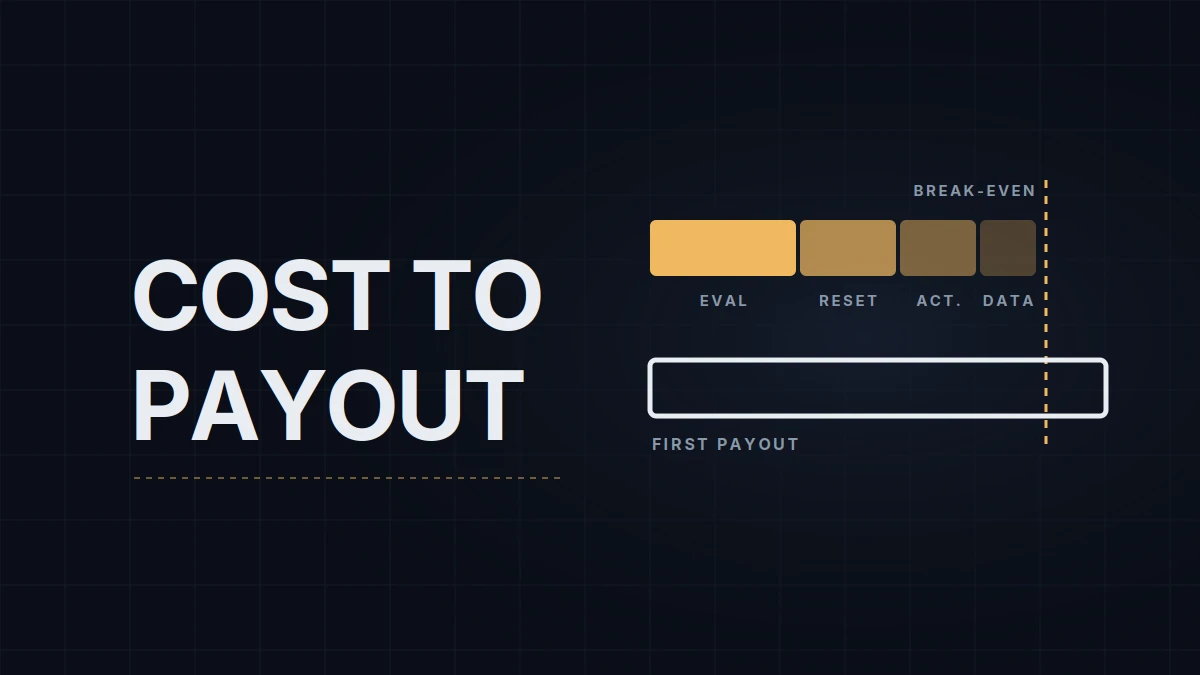
$95, $146, $165 and $198: that's what a funded 50K account costs on four price plans at three futures firms if you pass the first evaluation you buy, at list prices at the time of writing. Add one reset and the four become $190, $251, $274 and $247. The evaluation price is the number every sales page leads with, and it's one line of the bill. The prop firm activation fee, the resets, the data and the gate between the funded account and its first payout decide what reaching a payout costs.
If evaluations are new, what a prop firm evaluation is covers the structure. This post is the bill, line by line, for the 50K size, a common place to start.
One step, and the one after it
"One-step" and "two-step" describe how many phases an evaluation has. Two-step is the forex and CFD model: a challenge, then a verification phase with a target of its own, then the funded account. The large futures firms sell one step. At the time of writing Lucid, Topstep, Apex, Tradeify, FundedNext Futures and Alpha Futures all run a single evaluation, and FTMO, the firm best known for two-step challenges, uses one evaluation for its futures program.
The second step exists anyway, inside the funded account. Before the first payout can be requested, the funded account has to make a set amount of profit on qualifying days, sometimes above a buffer. On some accounts that gate is small; on one of the four below it's close to a second evaluation.
| 50K, at the time of writing | First step: evaluation target | Second step: before the first request | Smallest first payout, your share |
|---|---|---|---|
| LucidFlex | $3,000 | 5 days of $150 or more; $1,000 of profit for the $500 minimum | $450 of $500 |
| Topstep Express Funded, Standard payout option | $3,000 | 5 winning days of $150 or more; $250 of profit for the $125 minimum | $112.50 of $125 |
| Tradeify Select Flex | $3,000 | 5 winning days of $150 or more; $500 of profit for the $250 minimum | $225 of $250 |
| Apex EOD Performance Account | $3,000 | 5 days of $250 or more; $2,600 of profit (the $2,100 safety net plus the $500 minimum), with no day at 50% or more of it | $500 of $500 |
The Apex gate is 87% of its evaluation target again, the closest of these four to a two-step program. At Topstep and Tradeify the day count does most of the work: five sessions above the $150 minimum is at least $750 made on the days that count. At Lucid the $1,000 of profit behind the $500 minimum is the higher bar. Topstep also offers a Consistency payout option, three trading days under a 40% consistency rule with a higher cap. The full payout rulebooks for Lucid, Topstep and Apex, caps and cycles included, are in prop firm payout rules.
The bill, line by line
| 50K, list prices at the time of writing | LucidFlex, no daily loss limit | Topstep, standard pricing | Topstep, No Activation Fee pricing | Tradeify Select |
|---|---|---|---|---|
| Evaluation | $146 one-time | $49 a month | $95 a month | $165 one-time |
| Reset | $105 | $49 | $95 | $109 |
| Activation fee | none | $149 | none | none |
| Level 1 data | included | included | included | included |
| Passing on the first attempt | $146 | $198 | $95 | $165 |
| With one reset, or a second month | $251 | $247 | $190 | $274 |
Evaluation pricing comes in two shapes. Lucid and Tradeify charge once, with no time limit; Lucid also sells each LucidFlex size with a daily loss limit switched on, for less, and the prices here are for the version without one. Apex also charges once, for 30 calendar days of access and with no reset, so a breach or an expired clock both mean buying again; on its standard plans it adds a one-time activation fee for the funded Performance Account, due within 7 calendar days of passing, and its no-activation-fee plans cost more up front. A subscription charges for time instead: Topstep bills monthly until you pass, and a reset costs a month's fee and moves the next billing date to 30 days after the reset.
Topstep's two pricing options are a bet on your own speed. Standard pricing is cheaper each month and charges $149 when you pass; No Activation Fee pricing costs more each month and nothing at the end. Counting months and resets together:
| Months or resets before passing | Standard | No Activation Fee |
|---|---|---|
| 1 | $198 | $95 |
| 2 | $247 | $190 |
| 3 | $296 | $285 |
| 4 | $345 | $380 |
No Activation Fee pricing is cheaper up to three months or resets and standard pricing from the fourth on; the lines cross at about 3.2. A trader whose evaluations tend to take a while is better off with the option that's cheaper per month.
Data is the line that keeps billing. Level 1 is included on all four plans, but depth of market, which a heatmap needs, isn't: at the time of writing Lucid sells it as a monthly add-on, for CME alone or for all four CME Group exchanges, Topstep for $38 a month, and Tradeify leaves it to Tradovate's own billing. For comparison, CME's own non-professional depth fee in 2026 is $12.10 per exchange per month. For a trader who reads the DOM or a heatmap, that's a monthly charge through the evaluation and the funded stage. At Tradeify it also means picking Tradovate as the broker at checkout: the firm's Rithmic and WealthCharts accounts can't add depth yet. Payout methods can cost too: Topstep charges $30 on ACH and wire payouts (Wise and Aeropay carry no Topstep fee), so its smallest request arrives as $82.50 by ACH.
What the bill leaves out
The list price is rarely the price paid. Lucid, Apex and Tradeify run discount codes on evaluations much of the time, while resets are usually full price, and Tradeify says outright that its resets can't be discounted.
The bigger omission is the number of attempts. The table assumes you pass the evaluation you bought and that the funded account reaches its first request, and neither is the typical case. A hypothetical trader who passes one evaluation in three, and whose funded accounts reach a first request half the time, needs six evaluations per first payout on average. On LucidFlex at list price that's $146 for the first one, four resets at $105 after the failed evaluations and a new $146 evaluation after the funded account that failed: roughly $710. The smallest first payout ($450 in hand) doesn't cover it; the request would have to be about $790, which takes about $1,580 of funded profit under the 50% cap. How pass rates turn into expected cost is worked through in the reset math and instant funding vs evaluation, and why so many funded accounts end before their first payout is in passing an evaluation and failing the funded account.
So the useful comparison between firms isn't the evaluation price. It's the bill for the number of attempts you can expect, set against the payout the funded account can produce once the second step is cleared.
I trade LucidFlex accounts on Lucid (affiliate link), and the pricing shape is part of the reason: a one-time fee with no activation fee and no monthly clock means a slow week costs nothing extra.
Educational content, not investment advice. Futures trading involves substantial risk of loss. Examples are for illustration only. Read the full Risk Disclosure.