Prop Firm Sales and Discount Codes: What a 90% Off Evaluation Really Costs
A Black Friday code cuts the price of an attempt. Often it leaves the activation fee and later subscription months untouched, and it never changes the number of attempts you need. The expected cost of one funded account at three pass rates, with and without a discount, and a checklist for the cart.
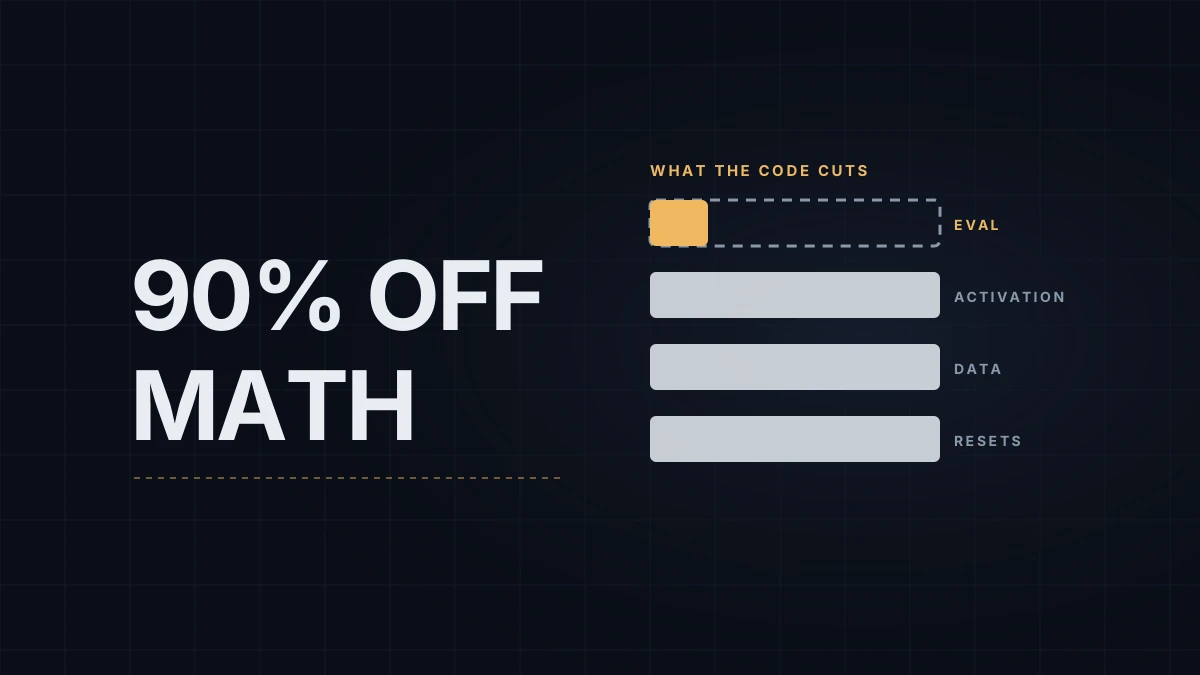
Ninety percent off makes an evaluation look almost free, and in the weeks around Black Friday (November 27, 2026) many futures prop firms run sales, the deepest of them at that level. The discount is real money. It also applies to one line of a bill that has several, and it leaves the number that decides your total cost, the share of your attempts that pass, exactly where it was. The rules don't change either: the same target, the same drawdown and the same consistency rule described in the prop firm evaluation guide apply to a $15 account and a $150 one.
What a sale touches
The full bill from purchase to first payout is broken down in what it costs to reach a first payout. Here is how the usual sale maps onto it.
| Line of the bill | Discounted in a typical sale? | What to check |
|---|---|---|
| One-time evaluation fee | Yes | The headline number |
| First month of a monthly evaluation | Yes | Whether months two and three stay discounted; at some firms they return to list price |
| Activation fee after passing | Sometimes | Some firms cut it or sell a no-activation version, many leave it alone |
| Reset fee | Sometimes | Whether the code applies to resets bought later |
| Market data and platform fees | Rarely | Monthly, and they keep running |
| Profit split, payout caps, drawdown | Not by the code | A code changes the price, not the rules; a promotion that changes a rule, such as Topstep's doubled payout caps with a daily loss limit, has its own terms |
The banner shows the percentage; which lines it applied to only shows up in the cart. At the time of writing, firms differ on this enough that two "90% off" offers can end in very different totals once the activation fee is added.
The expected cost of one funded account
Each attempt either passes or it doesn't. If a share p of your attempts pass, you need 1/p attempts on average to earn one funded account, so:
cost per funded account = evaluation price ÷ pass rate + activation fee
A hypothetical firm: a $150 one-time evaluation, a $100 activation fee that the sale doesn't touch, and an 80% off code that brings the evaluation to $30.
| Your pass rate | Attempts on average | At list price ($150) | At 80% off ($30) |
|---|---|---|---|
| 10% | 10 | $1,600 | $400 |
| 20% | 5 | $850 | $250 |
| 33% | 3 | $550 | $190 |
At a low pass rate the sale saves a lot, $1,200 per funded account in the first row. It is also why firms can afford deep discounts: their revenue comes mostly from fees, most evaluations don't pass, and a cheaper attempt sells more attempts. The post on how prop firms make money follows that money in more detail.
The bottom row shows the other side. Once the evaluation is cheap, the activation fee becomes most of the bill ($100 of $190), so a sale that cuts only the evaluation saves less the better you trade.
What the table can't show is the effect a cheap attempt has on the trader. If $30 accounts feel disposable and you start taking trades you'd skip on a $150 account, your pass rate falls. Dropping from 20% to 10% moves the sale column from $250 to $400 and, more to the point, doubles the number of failed evaluations between you and a payout. The fee is the cheap part of a failed attempt. The weeks are not.
Monthly evaluations: the discount fades
On a subscription, check how long the code lasts. Topstep's codes cover the first month unless stated otherwise, while Take Profit Trader's recent sales kept the discount on every month until the trader passed. Take a $100 monthly evaluation with 50% off the first month only. Pass in month one and you paid $50. Take three months and you paid $50 + $100 + $100 = $250 against $300 at list, an effective discount of about 17%. With a first-month code, the longer the evaluation runs, the less the sale was worth.
How urgent is the deadline?
Some firms discount almost all year. At the time of writing, one of the largest futures firms advertised 90% off all evaluations on its own site in early November, three weeks before Black Friday, and archived copies of its homepage show 80% to 90% off in every month of 2026 checked. A countdown timer tells you when this code ends, not when the next one starts. If you plan to buy evaluations this quarter anyway, a sale is a good time to do it. If you weren't planning to, the discount is a reason to buy that didn't exist yesterday.
Before you check out
- Price the whole path: evaluation, activation, monthly data, and the resets you usually need.
- Check whether the code applies to resets and later months, or only to today's purchase.
- Buy the number of accounts your plan already called for. A multi-pack is a discount on accounts you may not trade well at the same time.
- Read the refund terms. None of the futures firms checked for the fee refund guide returns the evaluation fee when you pass or with the first payout, so treat what you pay at checkout as spent.
Your pass rate is the number to improve before the next sale. The published figures in the pass rate post show how far apart "passed" and "paid" can be.
Educational content, not investment advice. Futures trading involves substantial risk of loss. Examples are for illustration only. Read the full Risk Disclosure.