Near the Floor on a Funded Account: Size Down, Pause or Let It Go
Your funded account has $400 left above the floor. Trading bigger to win it back fast is the instinct, and the numbers say it's the worst way to try. What 40,000 simulated paths show at three risk sizes, why size stops mattering without an edge, and when pausing or letting go is the better call.
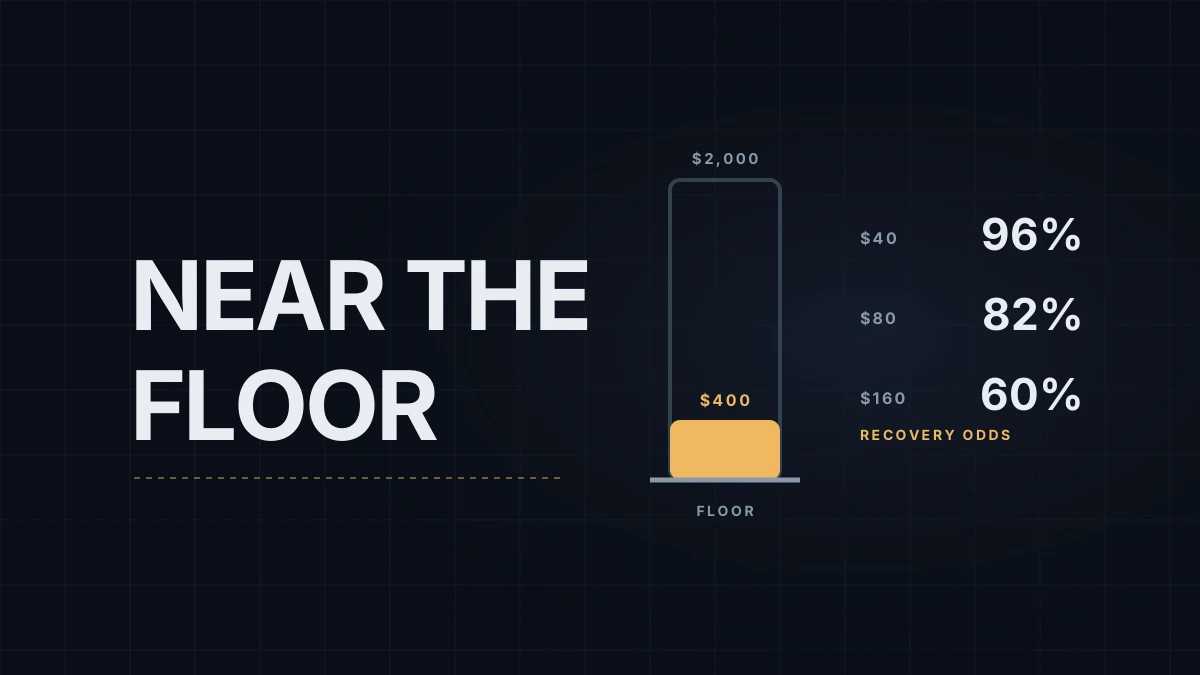
Your funded account had $2,000 of room above the floor. After a bad week it has $400. The floor won't drop back down (trailing drawdown only moves up, as the trailing drawdown guide explains), so getting back to full room means making $1,600 without losing $400 first. You have three choices: keep trading at a smaller size, stop for a while, or accept that the account is probably gone and save your energy for the next one.
Before choosing, it helps to be clear about what you're protecting. A funded account is worth what it will pay out in the future, after the rules described in the prop firm evaluation guide take their share. An account $400 from the floor is worth its chance of recovering, times the payouts that follow. That chance is something you can estimate.
What the recovery odds look like
The simulation below ran 40,000 paths for each risk size. The strategy wins half its trades at 1.5R and loses the other half at 1R, an expectancy of +0.25R per trade, which is a decent edge. Each path ends either at the floor or when the full $2,000 of room is back.
| Risk per trade | Losses in a row to the floor | Chance of getting back to $2,000 | Median trades to get there | Same odds with no edge |
|---|---|---|---|---|
| $40 (1 MNQ, 20-point stop) | 10 | 96.4% | 147 | 20.0% |
| $80 | 5 | 81.8% | 65 | 20.0% |
| $160 | 2.5 | 60.3% | 24 | 23.2% |
Two things stand out.
With an edge, small size wins on odds and loses on time. At $40 a trade the account recovers almost every time, but the median path takes 147 trades, which at three trades a day is about ten weeks. At $160 it takes under two weeks and fails four times in ten. Trading bigger to get it back fast is the instinct, and in this table it's the worst of the three sizes.
Without an edge, size barely matters. The last column is a coin flip at 1:1, and every size lands near 20%, which is $400 divided by $2,000. That's the gambler's ruin result: with no edge, your chance of reaching a target before the floor is roughly how far you are from the floor relative to the target, whatever you bet. (The $160 row runs slightly higher because $400 is two and a half losses, so it takes a third loss to go through the floor.) Smaller size only helps if the strategy has positive expectancy. The drawdown recovery math post works through the same logic for percentage losses.
The three choices, with their costs
Size down. The table's case. It costs time and patience, and it only makes sense if your expectancy is real, measured over enough trades to trust. If the drawdown came from a normal losing streak in a strategy that has worked for months, this is usually the right call. If you already trade 1 MNQ there's no smaller step, and a tighter stop instead changes the strategy you're relying on.
Pause. Stopping costs nothing in money, and it's the right answer when the drawdown came from you rather than the market: revenge trades, oversized positions, rules broken. A few days off doesn't change the odds in the table, but it can change which row you trade in when you come back. Read your firm's inactivity rule before you pause. Some firms close accounts with no trades for a set number of days.
Let it go. If the last column is the fair description of your strategy, because the edge was never measured or the market changed, the account is worth about 20% of its future payouts. Treating it as already lost frees you from trading it scared. Some traders keep trading it at minimum size as practice with real stakes; others put that time into a new evaluation. The when to reset an evaluation post covers the cost side of starting over.
Deciding before you're there
The worst moment to choose is at $400, after a loss, with the platform open. Decide now, while the account is healthy: at what cushion you cut size, to what, and what result would tell you the edge is gone. Write it next to the five numbers in your prop account tracker. When the account gets close, you follow a rule instead of a feeling.
Educational content, not investment advice. Futures trading involves substantial risk of loss. Examples are for illustration only. Read the full Risk Disclosure.