Prop Firm Pass Rates and Payout Rates: What the Published Numbers Say and What They Leave Out
Futures prop firms now print pass and payout statistics on their sites, and one firm can report 16.8% and 51.8% for the same year. A table of the published figures, what each one divides by, and the gap between passing, getting paid and going live.
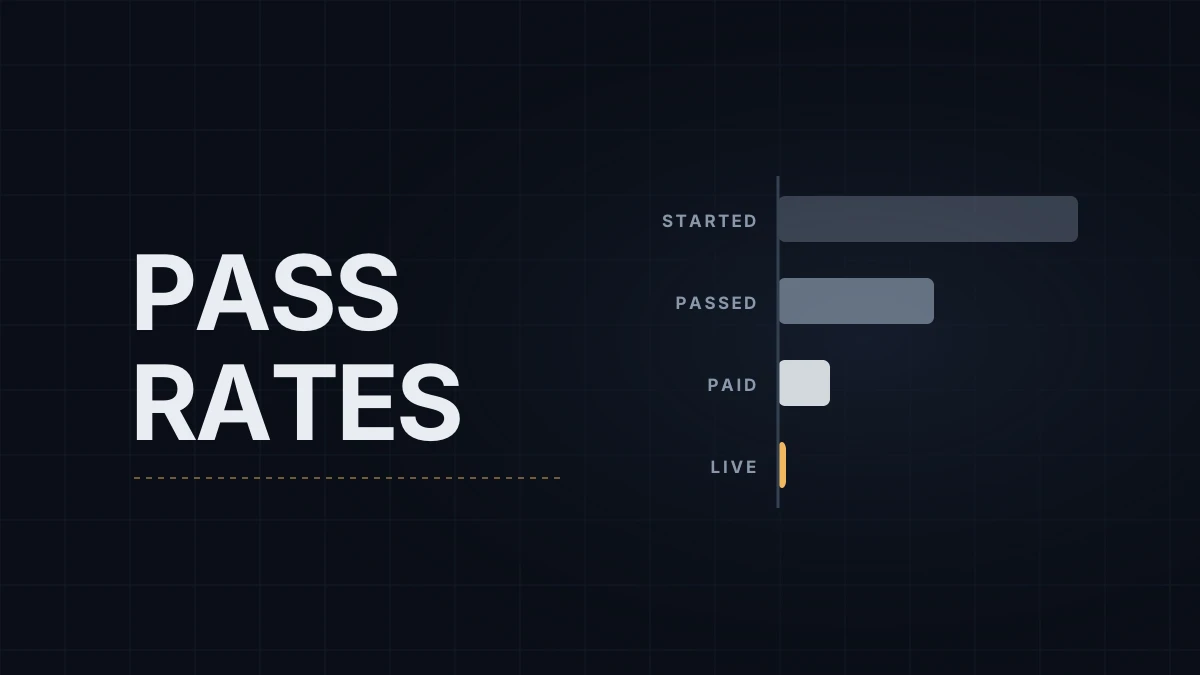
Topstep's pass rate for 2025 was 16.8%. It was also 51.8%. Both numbers sit in the same disclosure on Topstep's website: 16.8% of the Trading Combines started that year were completed, and 51.8% of the people who started at least one Combine passed at least once. The difference is the denominator, and most arguments about prop firm pass rates come down to two people quoting different denominators at each other.
Several US futures prop firms now publish a short block of trader statistics on their own sites. This post collects those figures as they stood in October 2026, explains what each one counts, and shows what none of them tell you. If the evaluation model is new to you, the pillar explains it from zero, and how prop firms make money explains why these ratios sit at the center of the business.
The published figures
| Firm | Passed | Funded traders paid at least once | Funded traders moved to live | Period |
|---|---|---|---|---|
| Topstep | 16.8% of Combines; 51.8% of traders | 33.3% | 0.71% | 2025 |
| Tradeify | 17.2% of evaluations; 40.3% of traders | 28.5% | 3.0% | August 2025 to July 2026 |
| MyFundedFutures | 19.97% of evaluation participants | 39.2% | 4.2% | Not stated |
| Take Profit Trader | 36.22% of Trading Tests | Not published | Not published | 2025 |
Every figure is self-reported and unaudited. Lucid Trading and Apex Trader Funding publish lifetime payout totals instead (Lucid's homepage says traders have earned more than $700 million; Apex's homepage counter shows about $880 million in compensation to customers since 2022), with no pass or payout rates, so they have no row here.
Accounts or traders
A trader who fails, resets, fails again and passes on the third try is one success in three accounts and one success in one person. Tradeify's disclosure hints at the size of that effect: participants can buy several evaluations and resets, and they started a median of three over the period. That is why its account rate of 17.2% and its trader rate of 40.3% sit so far apart, and why Topstep's two figures differ by a factor of three.
Both numbers are true; they answer different questions. The account rate says what one purchase is likely to do. The trader rate says what persistence eventually does, without saying how many paid attempts it took. For budgeting, the account rate is the one to use: at roughly one pass in six accounts, the evaluation fee is a cost you should expect to pay several times, along with the weeks each attempt takes (the evaluation timeline shows how many). The cost to first payout post turns that into a full bill.
MyFundedFutures says "participants" without saying whether it means people or accounts, and gives no measurement period. Take Profit Trader counts tests, and resets don't appear in its wording at all. Those two rows compare poorly with the first two.
Passing, getting paid and going live
A passed evaluation opens a funded account, which at these firms is almost always simulated. The second column measures how many funded traders received at least one payout, and the published figures sit between 28.5% and 39.2%.
Multiplying the trader pass rate by the payout rate gives a rough share of everyone who started and was eventually paid at least once: about 17% at Topstep (51.8% × 33.3%), about 11.5% at Tradeify and a little under 8% at MyFundedFutures. Those are my estimates, not published figures, and the two denominators don't line up exactly.
The last column is the smallest. Between 0.71% and 4.2% of funded traders were moved to a live account, where the firm puts its own capital behind the trades. Most funded accounts end well before that, often for the reasons in passing the evaluation and failing the funded account.
What the numbers leave out
Profit after fees. A payout of any size counts as "paid". None of the disclosures says how many traders withdrew more than they spent on evaluations, resets and activation fees, which is the figure most readers want. The closest public dataset comes from forex and CFD firms: in 2024 the back-office provider FPFX Tech gave Finance Magnates figures from about 100,000 traders across ten firms. About 14% were funded and about 7% received a payout, the average payout was around 4% of account size, and the average account had spent about $800 on challenges, typically three of them. Different market, different rules, the same shape as the futures disclosures.
A denominator for the totals. "$1.5B+ paid" on Topstep's homepage means little without fee revenue next to it, and no firm publishes both. The one case with both sides on record is My Forex Funds, a forex firm the CFTC sued in 2023. A court opinion at the preliminary-injunction stage cited more than $310 million in fees from at least 135,000 customers against at least $159 million paid out. The case was dismissed with prejudice in May 2025, so those are early findings from the case, not a judgment.
Stable definitions. Firms decide what to publish and when. Take Profit Trader's earlier figure, 20.37% for January to August 2023, counted registered users, while the 2025 figure counts tests. Rule changes, such as the new payout terms Topstep introduced in January 2026, also make one year a poor guide to the next.
Reading a disclosure before you buy
Find the footer or risk-disclosure page and check four things: whether the pass rate counts accounts or people, the period it covers, the share of funded traders who were paid, and the share who reached live. A firm that publishes all four is giving you more than a firm that shows only a lifetime payout total, whatever the totals say. A low number isn't a verdict on the firm either. The model is built on most evaluations failing, and risk of ruin explains why a fixed drawdown ends most accounts that trade without an edge.
The number I'd most like to see, the share of traders who ended up net positive after every fee, isn't in any disclosure yet. Until it is, I read the account-based pass rate as the price of entry and the live rate as the real ceiling of the model.
Educational content, not investment advice. Futures trading involves substantial risk of loss. Examples are for illustration only. Read the full Risk Disclosure.