How Much to Withdraw: Small Frequent Payouts vs Maximum Requests on a Funded Account
Every payout request moves money from the account's cushion to your bank, restarts the qualifying days and, on some firms, uses up one of a fixed number of payouts. Three ways to size requests, worked through on a Topstep 50K, and why small requests are the expensive choice on a payout ladder.
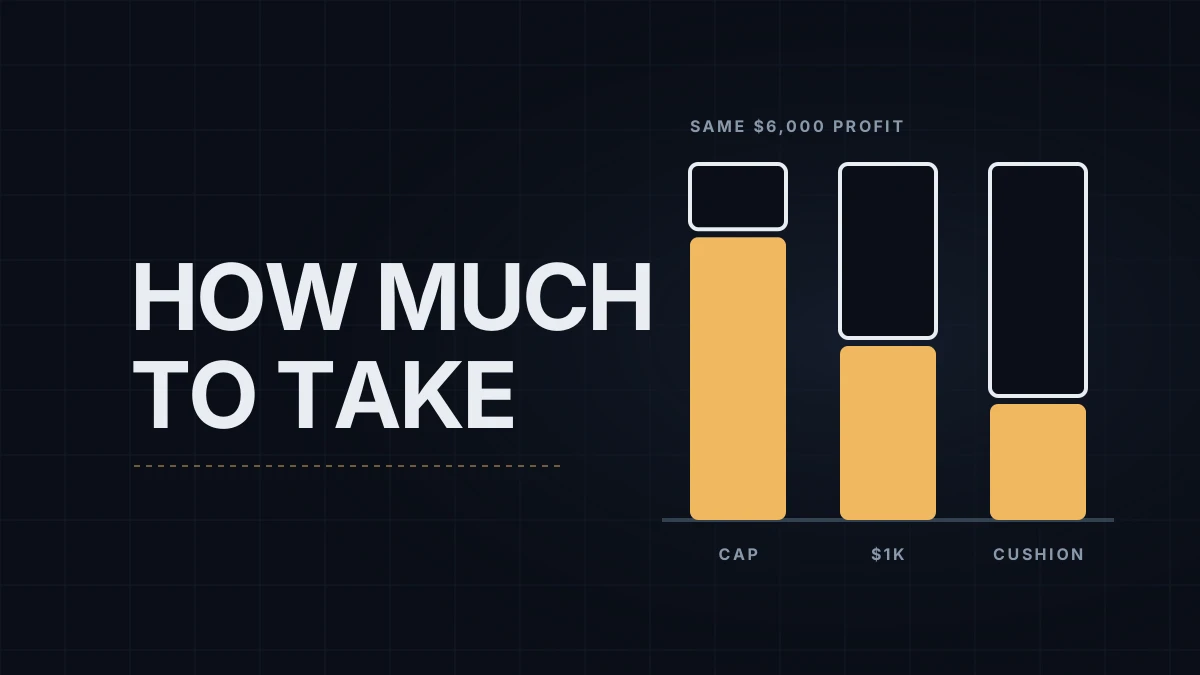
On a Topstep 50K Express Funded Account holding $4,000 of profit, the largest payout you can request is $2,000. Take it and $2,000 stays behind as the only cushion the account has. Take $1,000 and the cushion is $3,000. Neither is the right answer in general, because how much to withdraw from a prop firm depends on what each request costs on that particular rulebook, and on most rulebooks it costs more than the cash.
Payout rules explains qualifying days, buffers and splits, and payout caps sets out each firm's limits; if funded accounts are new to you, the pillar explains the model. This post is about the size of each request once you're eligible. Every rule below is a public 50K rule at the time of writing, October 2026.
What one request changes
A request moves money out of the cushion, the distance between the balance and the level that ends the account. At Topstep the maximum loss limit starts $2,000 below a $0 balance and trails up to $0, where it locks once the balance reaches $2,000 or the first payout is made, so from then on the balance is the cushion. On LucidFlex a request moves the floor to $50,100. On Apex's end-of-day accounts the $52,100 safety net stays in the account for its whole life and only profit above it can leave.
It also restarts the count. Topstep's winning days and LucidFlex's profit days start again from zero after every payout, and the consistency check at LucidPro (40%), LucidDirect (20%) and Apex (50%) measures the best day against profit since the last payout. Frequent requests mean many small windows, and in a small window one good day is a large share.
On some plans it uses up a step. LucidFlex, LucidPro and LucidDirect allow five payouts before the account goes to Lucid's live review, and Apex closes an end-of-day account after the sixth. Topstep publishes no such count. Topstep's payout FAQ adds one more cost: a payout that lowers the balance can lower the account's scaling level, which means fewer contracts allowed.
Three ways to size a request
The same hypothetical trader on a Topstep 50K, Standard path (five winning days of $150 or more, each request capped at half the balance and at $2,000, double that on Combines bought with a daily loss limit under an offer running since June 2, and after the first payout a request needs a positive result since the last one). Four payout cycles, $6,000 of profit in total, three request strategies:
| Cycle | Result | Cap every time: request / left in account | $1,000 each time | Cushion first: no request until $6,000 |
|---|---|---|---|---|
| 1 | +$4,000 | $2,000 / $2,000 | $1,000 / $3,000 | none / $4,000 |
| 2 | +$1,500 | $1,750 / $1,750 | $1,000 / $3,500 | none / $5,500 |
| 3 | −$1,000 | none / $750 | none / $2,500 | none / $4,500 |
| 4 | +$1,500 | $1,125 / $1,125 | $1,000 / $3,000 | $2,000 / $4,000 |
| Withdrawn | $4,875 | $3,000 | $2,000 | |
| To the trader at 90/10 | $4,387.50 | $2,700 | $1,800 |
All three made the same $6,000. The table only shows where it sits: in the bank or in the account. Now add a losing stretch of $1,200 after cycle 4. The cap strategy's $1,125 doesn't cover it and the account ends. The $1,000 strategy keeps $1,800, and cushion first keeps $2,800.
That's the trade in one line: cash now against the chance the account keeps paying. Taking the cap is right when the account's future is worth little to you, for example when a single bad week usually ends it anyway, or when you need the money on a schedule. A fixed smaller request suits a trader whose normal bad week is close to the drawdown. Cushion first costs the most cash early and leaves the largest buffer against a bad month; pass the evaluation, fail the funded account shows how often the first payout is where funded accounts end.
On a ladder, a small request costs a step
The arithmetic flips on plans that count payouts. A LucidFlex 50K pays at most $2,000 per request, and never more than half the profit, so a full request needs $4,000 behind it; the minimum is $500, and the account reaches the live review after five payouts. Five requests at the cap withdraw $10,000; five at the minimum withdraw $2,500 and use up the same five steps. At Apex, six requests at the end-of-day ladder's caps pay $13,000 and six $500 requests pay $3,000, and either way the account then closes.
So on a ladder the cushion is built by waiting, not by asking for less. The version traders use is to request close to the cap, but only once the balance after the request still leaves the cushion they want: on LucidFlex, a balance high enough that $2,000 can leave and the floor at $50,100 is still a comfortable distance away. The cost is time; each cycle can take more than five days.
I trade LucidFlex, so the five-request count is the part of this that applies to my own account.
Educational content, not investment advice. Futures trading involves substantial risk of loss. Examples are for illustration only. Read the full Risk Disclosure.