Pyramiding on a Prop Account: Adding to Winners Under a Trailing Drawdown
Pyramiding lowers the risk at the start of a trade and leaves full size at the top, which is where an intraday trailing drawdown charges for every point given back. A worked MNQ example, how averaging down differs, what Lucid, Apex, Topstep and Tradeify say about adding, and how to size the adds.
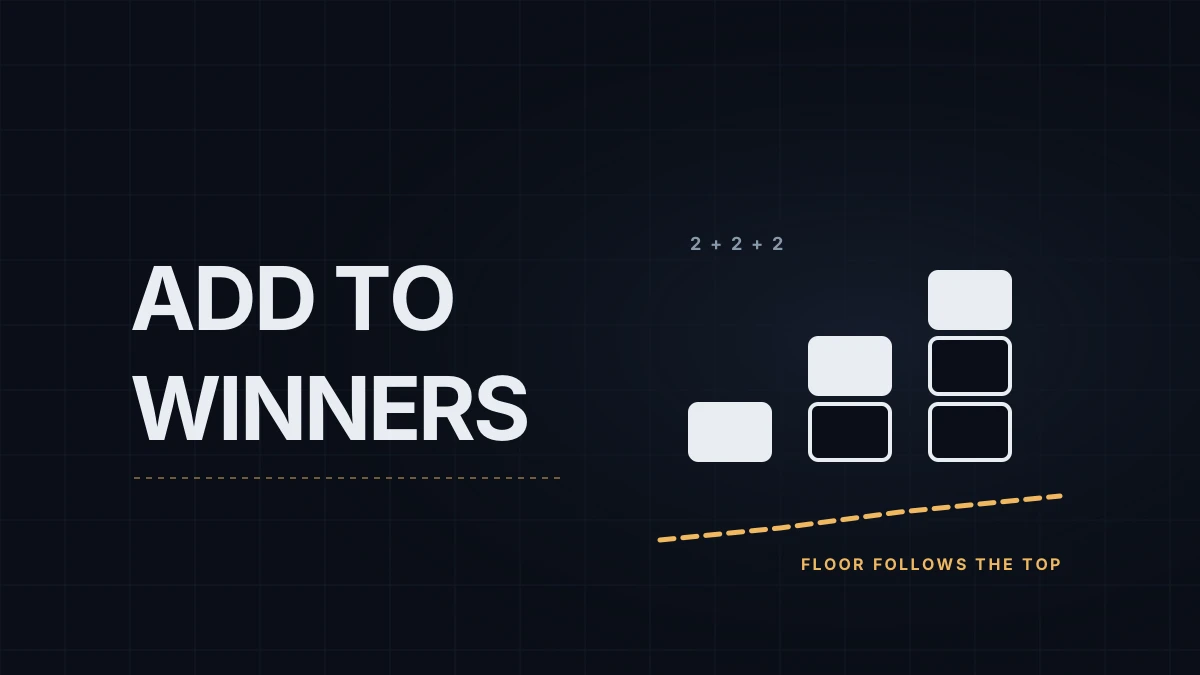
Pyramiding means adding to a position that is already in profit, so the position is smallest when the trade is least proven and largest when it's working. Averaging down is the mirror image: adding to a position that is losing, which improves the average price and raises the size exactly when the trade idea is weakest. On a prop account both run into the same two rules, the contract limit and the trailing drawdown, and they fail in different ways.
How evaluations and funded accounts work is covered in prop firm evaluations explained. The drawdown is the part that matters here: on an intraday trailing account the floor follows the highest equity the account has shown, open profit included, as trailing drawdown explained sets out.
One trade, three ways to hold six contracts
The account is a 50K with a $2,000 intraday trailing drawdown, so the floor starts at $48,000. The instrument is MNQ, the Micro E-mini Nasdaq-100, at $2 per point per contract. The hypothetical trade runs from the entry to +45 points, then reverses to +15, where the stop takes everything out.
The pyramid starts with 2 MNQ and a stop 15 points below the entry. At +15 it adds 2 more and moves the stop for all of them to the entry; at +30 it adds the last 2 and moves the stop to +15.
| 6 MNQ at entry | Pyramid 2 + 2 + 2 | 2 MNQ only | |
|---|---|---|---|
| Loss if stopped right after entry | $180 | $60 | $60 |
| Open profit at the +45 peak | $540 | $360 | $180 |
| Intraday floor after the peak | $48,540 | $48,360 | $48,180 |
| Result at the +15 exit | +$180 | $0 | +$60 |
| Room left above the floor | $1,640 | $1,640 | $1,880 |
The pyramid did what it promises at the start: a third of the risk of putting all six contracts on at once. It didn't help at the top. Both ways of holding six contracts lost exactly $360 of room in the reversal, because on an intraday trail the room lost is the open profit given back from the peak, and that depends only on how many contracts you hold at the top and how far price comes back: 6 contracts × 30 points × $2. A pyramid built as 3 + 2 + 1 gives the same $360, with a +$60 result instead of zero, at the cost of $90 of starting risk instead of $60.
On an end-of-day trailing account the same three trades leave $2,000 of room each, since the floor moves only with the closing balance and a scratch or a small winner doesn't push it up by more than the profit kept.
Averaging down runs the other way
The same six contracts built against the trade: 2 at the entry, 2 more at −10, 2 more at −20, with one stop for everything at −30. If the stop is hit, the loss is $240, four times the $60 of the original two-contract plan, and the size grew each time the market said the idea was wrong. On a $2,000 drawdown one such trade isn't fatal. The damage comes from the habit: averaging down works most of the time on a trade that eventually comes back, until a day when it doesn't, and that day is sized at the maximum.
What firms say about adding
At the time of writing, the four firms' rulebooks treat adding like this:
| Firm | Adding to a position | Limit the adds count against (50K) |
|---|---|---|
| Lucid Trading | Scaling in and averaging down are allowed; martingale, adding to losers in hope of recovery, is "strongly discouraged" | 4 minis or 40 micros; LucidFlex funded starts at 2 minis and scales with profit |
| Apex Trader Funding | No rule on adding in its prohibited activities; every trade needs a pending or mental stop, and the drawdown threshold can't be the stop | 6 minis on the evaluation; the funded account starts at 2 and scales by tiers set at the prior close |
| Topstep | No rule on adding in its prohibited strategies list | 5 minis on the Trading Combine; the Express Funded scaling plan starts lower |
| Tradeify | Averaging down allowed when it's part of a structured strategy | 4 minis or 40 micros |
Micros count ten to one against minis at all four in the evaluation. The limit applies to the whole open position, so the last add is the one that runs into it: at Apex an order that would exceed a Performance Account's limit is rejected without penalty, and on a Topstep Express Funded Account a position held over the limit for 10 seconds or longer can be reviewed. The general list of banned practices is in prohibited trading practices at prop firms, and how size grows on funded accounts in prop firm scaling plans.
Four ways to size the adds
- Equal adds. 2 + 2 + 2 is the simplest to manage and puts full size at the top of the move, so every reversal from the peak is charged at full size.
- Decreasing adds. 3 + 2 + 1 keeps the average price closer to the entry, so the same reversal ends with a better result, for a larger first entry. The give-back from the peak is the same.
- Add only when the existing units are protected. The next add goes in only once the stop on everything already open is at breakeven or better, so the trade's worst-case loss never exceeds the risk of the first entry, though the give-back from the peak still grows with every add.
- One size, no adds. Simplest of all; the cost is less profit on the trades that run furthest.
The journal app I'm building has a pyramiding simulator for exactly this arithmetic, because the give-back at the top is the number that small, tidy-looking adds hide.
Educational content, not investment advice. Futures trading involves substantial risk of loss. Examples are for illustration only. Read the full Risk Disclosure.