Trailing Stops vs Trailing Drawdown: How an Open Winner Moves Your Floor
A trailing stop gives back part of every move by design. On an intraday trailing drawdown the floor has already followed open profit to its peak, so that give-back comes out of your room. One hypothetical trade traced under intraday and end-of-day rules, and how traders handle it.
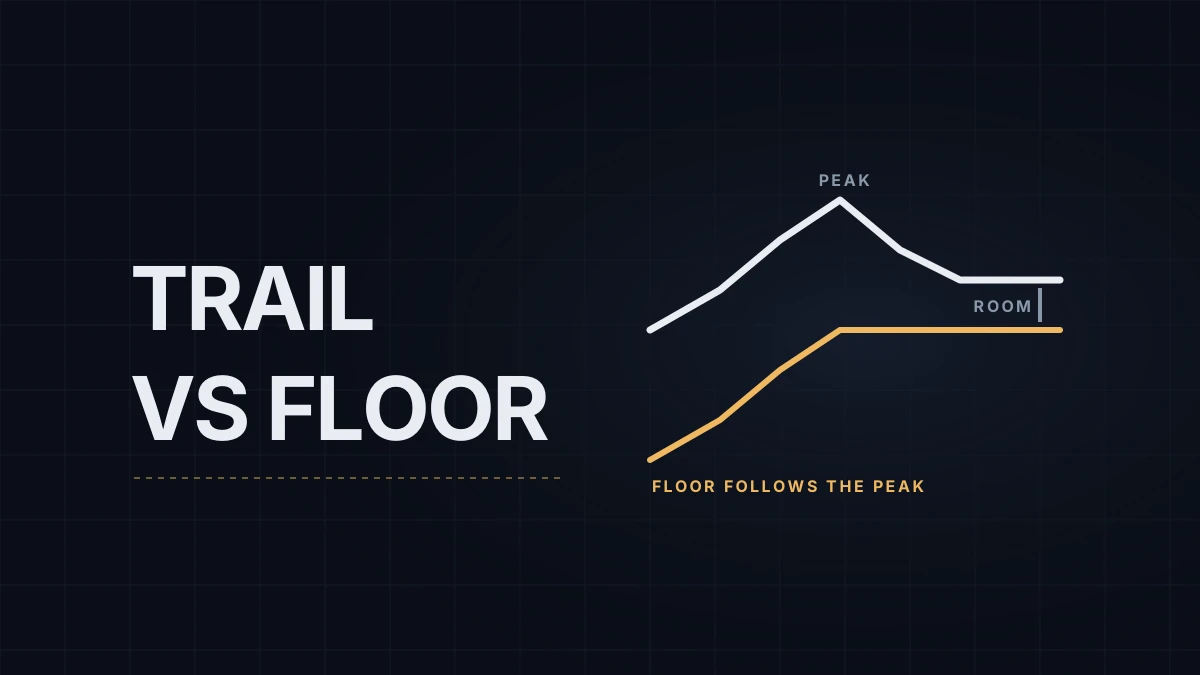
A trailing stop and a trailing drawdown both follow price upward, and on an intraday trailing account they follow different things. The trailing stop sits some distance behind the market and exits after a pullback. The drawdown floor follows the highest equity the account has shown, open profit included, and doesn't wait for the pullback. Every point a trailing stop gives back between the peak and the exit is a point of room the account has already lost.
The three ways firms measure the peak are covered in trailing drawdown explained, and the four common kinds of trailing stop in trailing stops explained. This post puts one of each on the same trade.
One trade, step by step
The account is a 50K evaluation with a $2,000 trailing drawdown, which puts the floor at $48,000, the balance where the account fails. The trade is a hypothetical long of 5 MNQ, the Micro E-mini Nasdaq-100, at $2 per point per contract, so every point is $10. The exit is a 30-point trailing stop. Apex Trader Funding's intraday evaluations use the first rule at the time of writing; LucidFlex and Topstep's standard Trading Combine use the second.
| Step | Price vs entry | Equity | Intraday floor | Room, intraday | End-of-day floor | Room, end-of-day |
|---|---|---|---|---|---|---|
| Entry | 0 | $50,000 | $48,000 | $2,000 | $48,000 | $2,000 |
| Running | +40 | $50,400 | $48,400 | $2,000 | $48,000 | $2,400 |
| Peak | +80 | $50,800 | $48,800 | $2,000 | $48,000 | $2,800 |
| Trailing stop fills | +50, closed | $50,500 | $48,800 | $1,700 | $48,000 | $2,500 |
| After the daily close | $50,500 | $48,800 | $1,700 | $48,500 | $2,000 |
The trade made $500. On the intraday account the room went down by $300, exactly the 30 points the trailing stop gave back from the peak. On the end-of-day account the floor moved only once, after the close, and only by the $500 the trade kept, so the room ends where it started.
The same mechanism looks worse on a trade that never pays. Take the same entry and the same run to +80, but with no trailing stop, only the initial stop at −20, and a reversal all the way down to it. The trade loses $200. On the intraday account the floor stopped at $48,800 when the open profit peaked, so the balance of $49,800 leaves $1,000 of room: a $200 loss has cost $1,000 of drawdown. On the end-of-day account the room is $1,800.
Why the two trailers collide
A trailing stop's give-back is a cost the trader chooses: a wider trail survives more noise and hands back more at the end. Under an intraday trailing drawdown that cost is charged twice, once to the trade's profit and once to the account's room, because the floor already banked the peak. The tighter the trailing stop, the less room each winner costs, and the more often ordinary pullbacks close good trades early. The double charge ends once the floor locks: on many accounts the drawdown stops trailing at a set level, which for Apex's funded accounts is the starting balance plus $100 at the time of writing.
How traders handle it
- An end-of-day account. The floor moves only on the closing balance, so give-back during the day costs no room at all. The cost can be a higher price or other rules, such as the $1,000 daily loss limit on Apex's 50K end-of-day evaluation.
- Partial exits. Taking part of the position off at a fixed profit lowers the open equity that the floor follows on the rest. The cost is a smaller position on the trades that run furthest.
- A smaller position. Fewer contracts mean a smaller swing in open profit, so the peak lifts the floor less. The cost is a smaller result on every trade.
- A tighter trailing stop. Less give-back per winner, at the price of more winners closed on noise. MAE and MFE explained shows how to measure how much room winners need.
I trade LucidFlex, an end-of-day account. My exits start from a target of about 35 points and turn into a trailing stop when the move has room for more, and on an intraday trailing drawdown that trailing part would pay twice for whatever each winner gives back from its peak.
Educational content, not investment advice. Futures trading involves substantial risk of loss. Examples are for illustration only. Read the full Risk Disclosure.