Logging the Trades You Didn't Take: Measuring What Discretion Adds
A discretionary trader runs two strategies at once: the written setup, and the judgment about which signals to take. Logging skipped signals and off-plan trades next to the taken ones shows which of the two makes money, and splitting the skips by reason shows where judgment helps and where it costs.
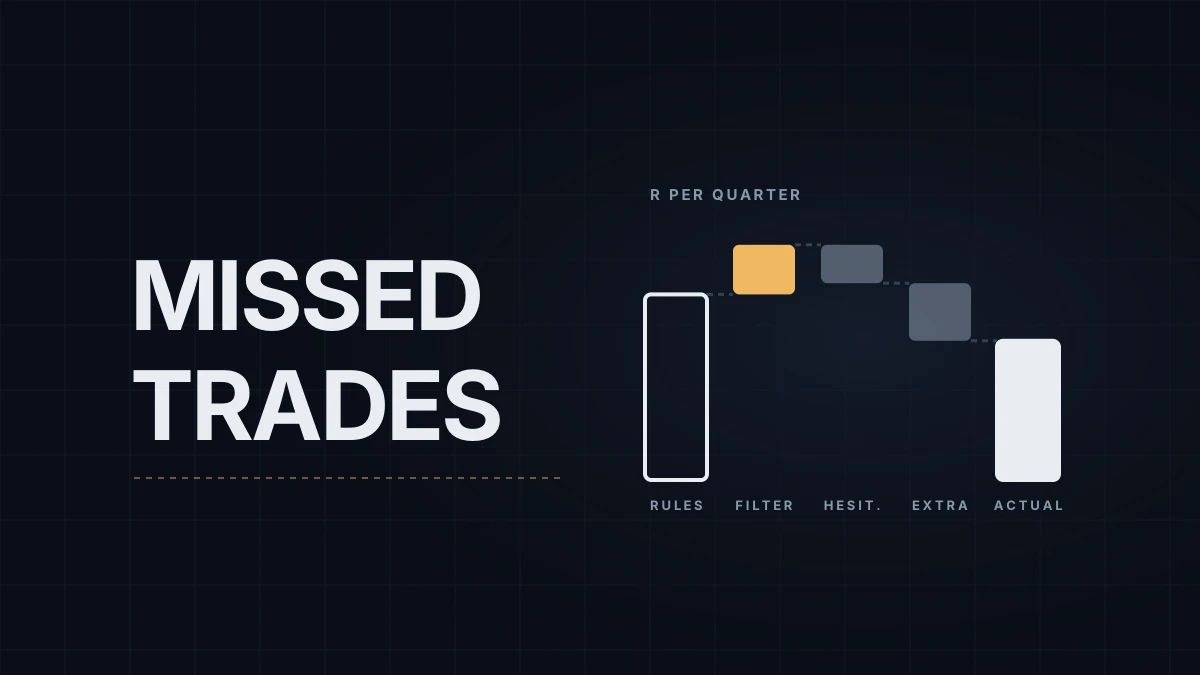
Every discretionary trader runs two strategies at the same time. One is the written setup: a signal defined well enough that two people looking at the same price chart would agree it happened. The other is the judgment layered on top: which signals to take, which to pass on, and which trades to take that the setup never asked for. A normal journal measures only the combination. A missed trades journal separates them, so you can see whether the judgment adds anything to the setup or quietly subtracts from it.
Hesitation at the entry introduced the basic log of skipped signals as a way to measure freezing. This post widens the question from "do I freeze?" to "what does my discretion earn?", which needs one more group of trades and a reason code on every skip.
Four groups, one baseline
Every trade and every valid signal lands in one of four groups:
- Signals taken. The setup appeared and you traded it.
- Signals skipped on purpose. You passed for a reason you'd defend: context against it, news within minutes, a range too tight to reach the target.
- Signals skipped by hesitation. You meant to take it and didn't, or reached for the order too late.
- Off-plan trades. Trades taken without a valid signal.
The baseline is the setup traded mechanically: every signal, taken or skipped, at the plan's stop and exit. Comparing your actual result with that baseline gives the net value of discretion, and the groups show where it came from.
Here is a hypothetical quarter for a trader with a setup worth a small positive expectancy, measured in R (one R is the planned risk on a trade):
| Group | Trades | Total | Average per trade |
|---|---|---|---|
| Signals taken | 44 | +12.3R | +0.28R |
| Skipped on purpose (context) | 11 | −3.1R | −0.28R |
| Skipped by hesitation | 5 | +2.4R | +0.48R |
| Off-plan trades | 9 | −3.6R | −0.40R |
All 60 signals traded mechanically would have made +11.6R (12.3 − 3.1 + 2.4). What the trader booked was +8.7R: the signals taken plus the off-plan trades. Discretion cost 2.9R over the quarter, and it came from three directions. The context filter helped, keeping the trader out of signals that lost 3.1R. Hesitation cost 2.4R, the net result of five signals the trader meant to take. The off-plan trades lost 3.6R and wiped out everything the filter had saved. A trader looking only at the 53 trades in the journal would conclude the setup is fine and the results a little disappointing, and wouldn't see that the judgment is doing two opposite things.
Scoring a trade that never happened
The log is only as honest as the scoring of skipped signals, and hindsight bends that scoring in one direction: the skipped signals you remember are the ones that worked. Three rules keep it straight.
Log the signal when it happens, with the time and a screenshot, before you know the outcome. A signal noticed only after the move is a hindsight entry and stays out of the sample.
Score it by the plan's rules, decided in advance: the same stop, the same exit or trailing method, and a fill one tick worse than the signal price, or no fill at all when a limit order only touched the level. Skipped trades have no real fills, so give them conservative ones.
Write the reason code at the moment of the skip. "Context" written at 10:02 AM means something; "context" written at 4:00 PM, after the trade would have won, usually means hesitation.
How much the numbers can say
Not much, at first. Single trades in R vary a lot, roughly 1.3R around the average for a setup like this one, so the average of 11 context skips has an uncertainty of about ±0.4R and the average of 5 hesitation skips about ±0.6R. The −0.28R and +0.48R in the table are hints, not findings. How many trades before you judge a setup works through the arithmetic. What the log can do early is show the size of each group: nine off-plan trades in a quarter is a fact long before their average means anything.
What to do with the answer
The split points to different fixes. A filter that keeps saving R over a few hundred signals is worth writing down as a rule, which moves it from judgment into the setup. A filter that keeps costing R is worth dropping, and trading the setup closer to mechanically, the trade-off discussed in discretionary vs systematic trading. Hesitation losses call for the fixes in the hesitation post. Off-plan trades need a rule that makes them harder to place, such as a maximum number of trades per session or an order template that only exists for the setup.
A sample log, one row per signal or off-plan trade, can sit in the same sheet as the trading journal:
| Time | Setup | Group | Reason | Plan result | Actual result |
|---|---|---|---|---|---|
| 09:41 | Level reversal | Taken | +1.5R | +1.5R | |
| 10:02 | Level reversal | Skipped on purpose | Context: trend day | −1.0R | 0 |
| 10:47 | None | Off-plan | −1.0R | ||
| 11:15 | Level reversal | Skipped by hesitation | Late | +2.0R | 0 |
| 13:30 | Level reversal | Taken | −1.0R | −1.0R |
Educational content, not investment advice. Futures trading involves substantial risk of loss. Examples are for illustration only. Read the full Risk Disclosure.