Hesitation at the Entry: Why Traders Freeze on Valid Setups and What to Measure
Hesitation costs twice: the late entry shrinks the reward per unit of risk, and the skipped trades are rarely random. A worked example in R, a simple log for signals taken and skipped, and four ways traders take the decision out of the moment, each with its own cost.
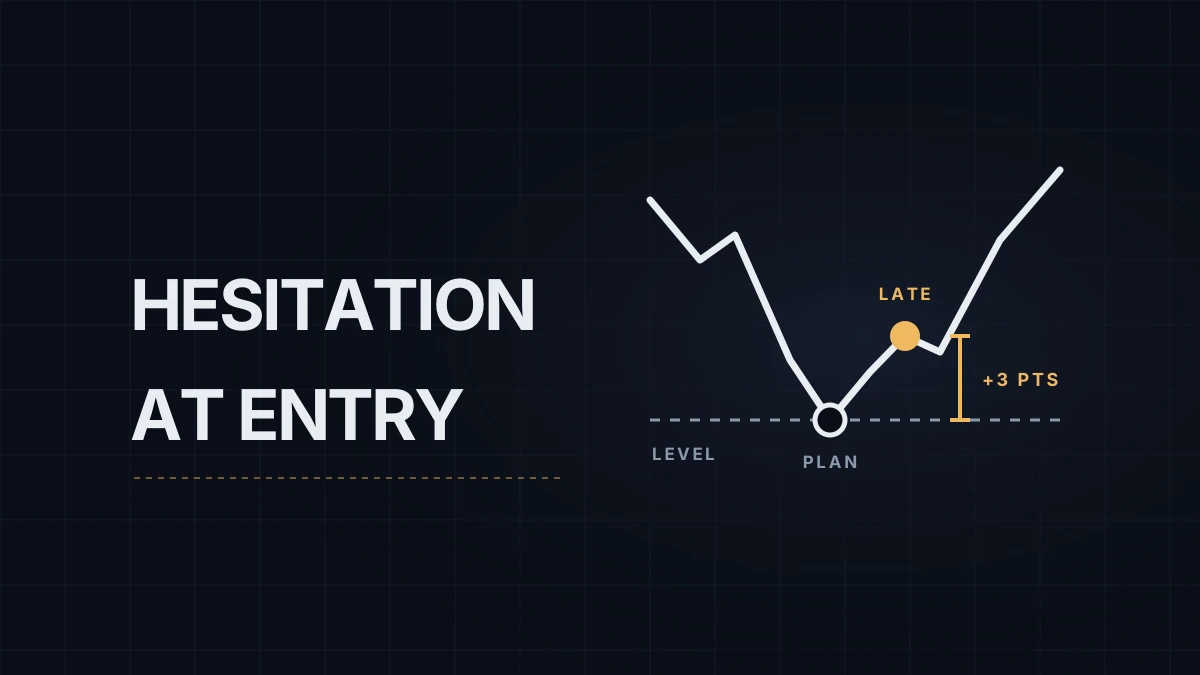
A long setup at a level with an 8-point stop and a 16-point target pays 2R, two units of the risk taken. Enter it 3 points late, because one more bar seemed like a good idea, and the same stop and target leave 11 points of risk for 13 points of reward: 1.18R. Nothing about the trade changed except the wait, and the wait took about 40% of the reward per unit of risk.
That's hesitation in trading at its smallest: a gap between seeing a valid setup on the chart and placing the order. The setup is in the plan, the level was marked in advance, the conditions are met, and the hand doesn't move. Sometimes it moves late. Sometimes it doesn't move at all.
The trades that never happen
The skipped trades cost more than the late ones, because they aren't a random sample. The two situations traders most often describe are right after a loss or two, and when price comes into the level fast, which is when entering feels most like stepping in front of something. Both groups can hold a share of the best trades a setup produces.
A hypothetical month makes the arithmetic visible. A setup with an expectancy of +0.3R per trade gives 40 valid signals, worth about +12R if all are taken. The trader takes 30 and skips 10. If the 10 skipped included five 2R winners and five 1R losers, they were worth +5R between them, and the 30 taken produced +7R. The month's journal now describes a weaker strategy than the one being traded, and the natural conclusion, that the setup is fading, is wrong. Trading expectancy explains why a few R missing from a small sample moves the picture this much.
Late entries leave a second fingerprint. A trader who keeps the usual 8-point stop distance from the late entry, and pushes the target out to keep 2R, ends up with the stop 3 points closer to the level, where an ordinary retest can reach it, and gets stopped out of trades that would have worked from the planned entry.
Measuring it
Hesitation stays invisible until the skipped signals are written down next to the taken ones. A log needs only five columns: time, setup, taken or skipped, a one-word reason for skipping ("loss", "fast", "unsure", "late"), and the result in R as the plan would have managed the trade. Thirty to fifty signals are enough to start seeing whether the skipped group differs from the taken one, though not to prove it, and the reason column usually shows which of the two situations above does the freezing. The fields fit into an ordinary trading journal template.
Two other numbers help. The average distance between planned and actual entry, in points, shows the size of the late-entry tax. And maximum adverse excursion (MAE), the furthest a trade moved against the entry before it closed, shows how far valid trades usually go against you; if most winners pull back a third of the stop or less before working, the fear that freezes the hand at the level is fear of something the data says is routine. MAE and MFE explained covers how to collect it.
Four ways to take the decision out of the moment
Smaller size. Cutting size until a full stop no longer stings is the most common first fix, because the trade stops being a referendum on the account. The cost is slower progress, which on a prop evaluation with a profit target means more trading days.
A resting order. A limit order placed at the level before price gets there, with the stop and target attached, moves the decision to a calm minute. What remains in the moment is whether to cancel, which is a smaller decision than whether to enter. The cost is fills taken in conditions you would have vetoed with fresh eyes, such as a spike into the level on a news release.
A written trigger. Two or three conditions that make a setup valid, checked off rather than felt, turn "is this good enough" into "are these true". The cost is rigidity while the rules are new, and the occasional valid trade the checklist didn't anticipate.
Repetitions in replay. Taking the same entry dozens of times in NinjaTrader's Market Replay builds the habit without the money. The cost is time, and replay never carries the same weight as a live order, so it helps the mechanics more than the fear.
Freezing tends to come in phases, which is one reason to grade the day's A, B and C game rather than single trades: a run of skipped signals can show up as a C-game pattern before it's obvious in the P&L.
My own entries rely on a trigger rather than a resting order: a failed break that reclaims, or a rejection, at a level marked before the session, with the stop and target going in through the ATM. Where to trade is settled before the session, so what's left at the level is whether that trigger printed.
Educational content, not investment advice. Futures trading involves substantial risk of loss. Examples are for illustration only. Read the full Risk Disclosure.