Tilt in Real Time: Physical Signs Before the Bad Trade
Trading tilt is easier to catch in a clenched jaw than in a thought, because thoughts argue and the body doesn't. A map of early, middle and late signs, one prepared action for each stage, and four steps to build your own map from the journal and session recordings.
Most of the General section is about reading the chart, starting from how to read a price chart. This post is about reading the person in front of it.
Trading tilt, in Jared Tendler's framing from The Mental Game of Trading, is anger taking over decisions, and it usually builds in steps rather than arriving all at once. Revenge trading is what the late steps look like on the order ticket: a loss, a story about why the next trade will fix it, and a size taken from the loss instead of the chart. The early steps are quieter, and the place they show first is usually the body. A thought can talk itself into "one more trade"; a jaw that has been clenched for ten minutes has no opinion, it's simply there to be noticed.
The map: signs and the action tied to each stage
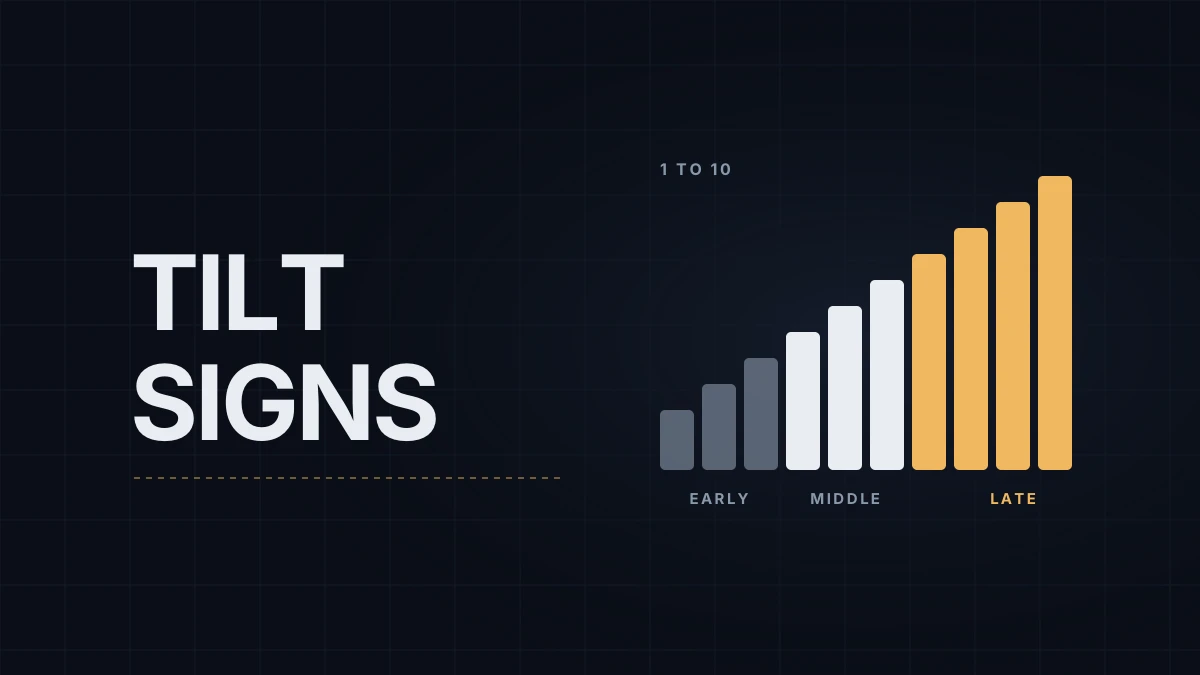
Tendler suggests rating the intensity on a scale from 1 to 10 and mapping what each level looks like for you. The signs below are a common starting set. Some won't apply to you and you'll have others; the point of the map is that each stage has one action decided before the session, when you're calm.
| Stage | What you can notice | Prepared action |
|---|---|---|
| Early (1 to 3) | Jaw or shoulders tightening. A sigh or a muttered word after a few ticks against you. Checking open P&L between ticks. Clicking harder or faster than the task needs. | Write the time and the sign in the journal. Breathe out slowly once. Re-read the entry trigger before the next order. |
| Middle (4 to 6) | Heat in the face or neck. Heart rate noticeably up. Leaning toward the screen. Hand resting on the order button before the setup has finished. Skipping the screenshot or the journal note. | Stand up and leave the desk for 10 minutes. Cancel any resting order that isn't in the plan. |
| Late (7 to 10) | Thinking about the loss instead of the chart. Switching to a faster chart or another instrument. Changing size or the stop "just this once". | End the session. A daily loss limit that locks the account (the firm's, the account's risk settings or an add-on) makes this automatic, see daily loss limits in NinjaTrader. |
The table holds twelve signs, and the order matters more than the list. Early signs are cheap to act on because nothing has gone wrong yet; at the late stage the only reliable action is the one that doesn't depend on judgment, which is why it's a hard limit rather than a decision.
Building your own map
- After each session, write down the first sign you noticed and the clock time. Then write what happened in the next fifteen minutes. A week of entries shows which signs show up first for you.
- Check the record, not only the memory. Executions in the platform give exact times. A session recording shows the minutes before each trade you'd grade as a C game in an A-to-C analysis: how fast you were clicking, which windows you opened, how long the hand hovered.
- Rank the signs by how early they appear. Your map is the first two or three. Signs that only appear after the bad trade belong in the post-session review, not in the live checklist.
- Revisit the map every month. Signs drift. Once one gets caught reliably, the next one in line becomes the early warning.
A heart-rate reading from a watch can sit next to the journal entry as one more data point. It isn't a diagnosis of anything, only a number that tends to move before the hand does.
I record my sessions for later review, and the same footage turns out to be a more honest record of what I was doing before a bad trade than my own recollection of it.
Educational content, not investment advice. Futures trading involves substantial risk of loss. Examples are for illustration only. Read the full Risk Disclosure.