Revenge Trading: The Sequence From One Loss to the Oversized Trade
Revenge trading rarely feels like revenge from the inside; it feels like the obvious next trade. The sequence from one ordinary stop to a trade three or four times the usual size, the arithmetic that doubles the size, and four places to break the chain before it reaches the account.
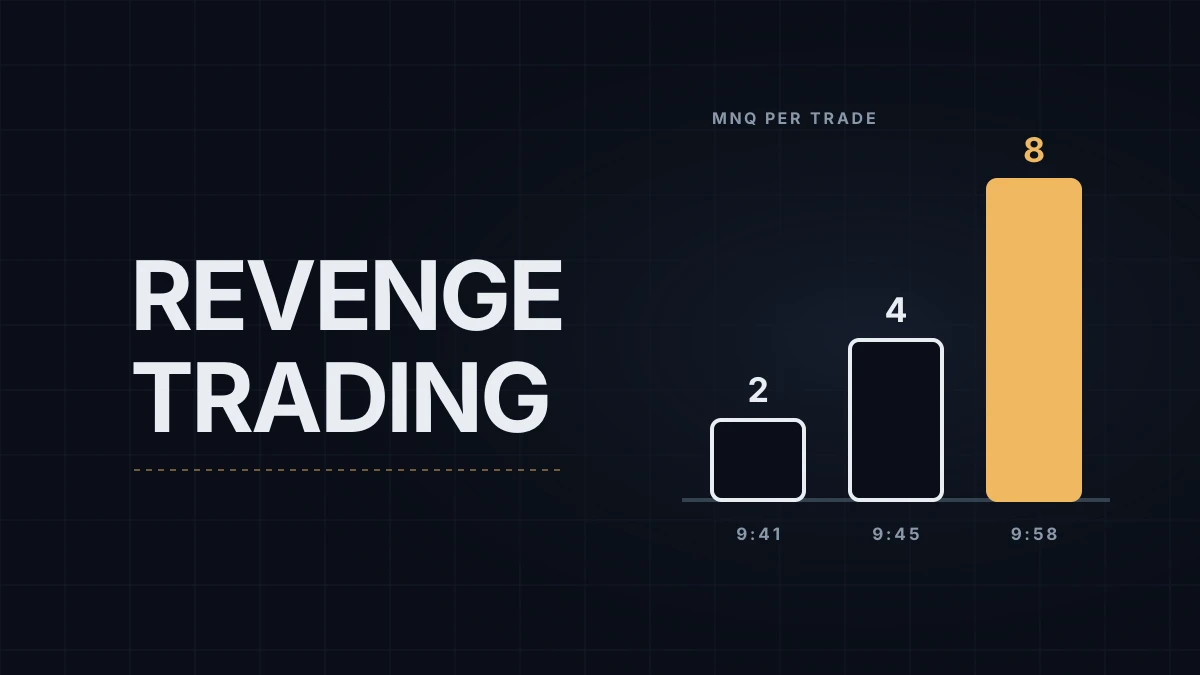
Revenge trading is a trade taken to win back a loss rather than because a setup appeared. The definition is easy. Recognizing it in the moment is hard, because from the inside it doesn't feel like revenge. It feels like the obvious next trade.
Nothing on the price chart changes in the few minutes after a stop. What changes is the trader's reference point: before the loss, the next trade is judged against the plan; after it, against getting back to zero. Here is a hypothetical morning on a 50K evaluation with a $2,000 trailing drawdown, trading MNQ, the Micro E-mini Nasdaq-100 at $2 per point:
| Time (ET) | Trade | Size | Result | Day so far |
|---|---|---|---|---|
| 9:41 | Long at a level marked before the open, 50-point stop | 2 MNQ | −$200 | −$200 |
| 9:45 | Long again at the same level, no new signal | 4 MNQ | −$400 | −$600 |
| 9:58 | Short the breakdown "to get it all back", stop moved further away once and hit 50 points from entry | 8 MNQ | −$800 | −$1,400 |
Seventeen minutes, 70% of the drawdown, and only the first $200 came from a trade the plan asked for.
Loss, story, size
The loss that starts it is rarely the worst of the week. More often it's one with an extra sting: stopped by a tick before price ran the planned way, a loss right after a large win, or the loss that turns a green day red.
Then comes the story, a sentence between the stop and the next order: it was right, just early; the level will hold the second time; one good trade fixes the day. The sentence turns the next entry into a correction of a mistake rather than a new decision, and a correction doesn't get checked against the plan the way a new decision would. The 9:45 trade had a reason. It didn't have a setup.
Size follows from the story. Once the goal is to recover $600, the target and the size come from the loss instead of from the chart. With a 30-point target, $600 needs 10 MNQ. Ten feels reckless, eight feels like a compromise, and eight is four times the planned size. The original stop doesn't fit that size either, so it gets moved, which is how the 9:58 trade lost $800.
Jared Tendler, whose work is reviewed in The Mental Game of Trading, treats this as one form of tilt: anger at the market or at yourself taking over the decision. The label matters less than noticing that each step is small and feels reasonable, which is why the sequence is hard to stop from the inside once it has started.
Where the chain breaks
Each step has its own interrupt, and each interrupt costs something different.
Before the first loss, a daily loss limit set in dollars or in stops before the session. A $500 limit would have ended the morning after the second trade, at −$600, instead of −$1,400. The cost is the occasional day that would have recovered. NinjaTrader 8 has no setting that ends the day after a loss, so daily loss limits in NinjaTrader 8 goes through the firm, broker and platform layers, including lockouts that block new orders for a set time.
Between the stop and the next entry, a fixed pause after any loss, measured on the clock and spent away from the order entry. The 9:45 re-entry came within minutes of the first stop, and re-entering within minutes of a stop is a typical line in the C-game column of an A-to-C game map. The cost is the rare good setup that appears inside the pause.
At the entry, the same proof the first trade needed: a setup from the plan, at a level marked before the open, written down in one line before the order goes in. If the line reads "the level will hold this time", that is the story talking.
At the size, a size fixed for the day and an order-entry template that defaults to it. Raising size after a loss is the single step that turns a bad morning into a lost account, and taking the decision away in advance costs nothing in money.
The journal is where the pattern gets a price. A tag for every trade entered within fifteen minutes of a stop, with the month's total P&L for those trades, shows what the habit costs in dollars, which is easier to act on than a vague sense that the afternoons go badly.
None of these interrupts relies on willpower at 9:58, which is the point. By then the trader in the table didn't have any left.
Educational content, not investment advice. Futures trading involves substantial risk of loss. Examples are for illustration only. Read the full Risk Disclosure.