How Many Funded Accounts for $2,000 a Month? Payout Caps, Splits and Honest Math
Payout caps rarely stop a $2,000 month; points per contract do. The payout rules of four 50K plans, a table of what 1, 3 or 5 funded accounts must each make in MNQ and NQ points, what the table leaves out, and what the firms' own payout rates say about accounts that never pay.
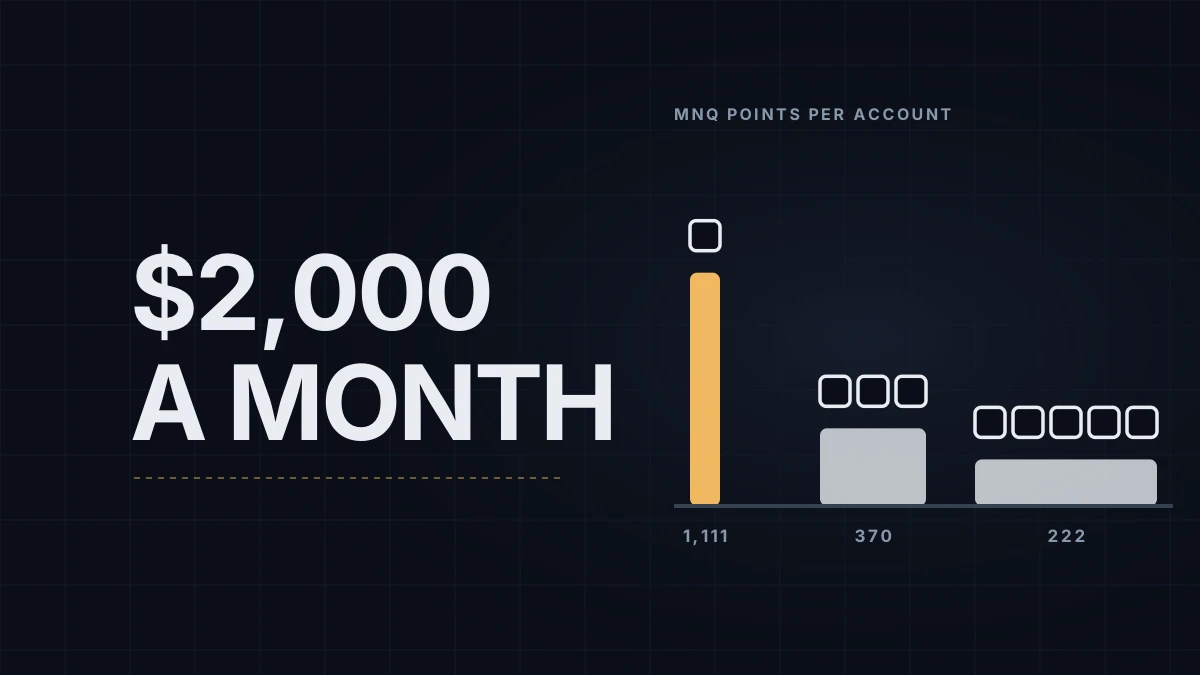
Two thousand dollars a month in your own account, after a 90/10 profit split, is $2,222 of approved payouts. On a 50K funded account the payout rules allow that: the usual cap is about $2,000 per request, and a month has room for more than one request. What decides how many accounts the target takes is a less comfortable number, the points each contract has to make.
If funded accounts are new to you, the pillar covers the model, and payout caps and ladders covers the limits used below. Every rule here is a public rule for 50K accounts at the time of writing, October 2026.
The rules the arithmetic runs on
| 50K plan | Split | Each payout needs | Most per request | Ends or reviewed after |
|---|---|---|---|---|
| LucidFlex | 90/10 | 5 days of $150 or more | Half the profit, up to $2,000 | Payout 5, live review |
| Topstep Express Funded, Standard path | 90/10 | 5 winning days of $150 or more | Half the balance, up to $2,000 | No fixed number |
| Tradeify Select Flex | 90/10 | 5 days of $150 or more | Half the profit, up to $2,500 | Live consideration after payout 3 |
| Apex end-of-day performance account | 100% | 5 days of $250 or more, no day at 50% or more | $1,500, rising to $3,000 | Payout 6, account closed |
Three of the four share one skeleton: five days of $150 or more per request, half the profit up to a cap of about $2,000, and a 90/10 split. Topstep counts half the balance, which on its funded account starts at $0, so it comes to the same thing. The arithmetic below uses that skeleton. Apex pays 100% and asks for $250 days, and its ladder of caps ends the account after the sixth payout.
The calculator
The table splits $2,222 a month across one, three or five funded 50Ks that copy the same trades, and turns each account's share into net points before commissions. MNQ pays $2 a point, NQ $20.
| Funded 50Ks | Payouts from each, per month | Requests each at a $2,000 cap | Net points each at 1 MNQ | At 2 MNQ | At 1 NQ |
|---|---|---|---|---|---|
| 1 | $2,222 | 2 | 1,111 | 556 | 111 |
| 3 | $741 | 1 | 370 | 185 | 37 |
| 5 | $444 | 1 | 222 | 111 | 22 |
Read down a column and the account count changes the work; read across a row and the size does. One account at 1 MNQ needs 1,111 points a month, about 53 points net on each of 21 trading days. Five accounts at 1 MNQ need 222 points each, and so would a single account trading 5 MNQ.
That last pair is what the table is for. Five copied accounts at one micro each and one account at five micros make identical money on identical trades. The difference is the drawdown behind each contract. Five accounts give every contract its own $2,000, which is 1,000 points at 1 MNQ. One account at 5 MNQ makes all five contracts share one $2,000, which is 200 points. More accounts don't add edge; they buy more drawdown per contract, at the price of more evaluations and fees.
Turned around, the table answers the title question from your own numbers. If a setup nets 200 MNQ points per contract in a month, $2,222 takes about 5.6 contracts' worth: six accounts at 1 MNQ, or three at 2 MNQ. At 100 points a month it takes twelve accounts at 1 MNQ, more than Lucid or Topstep let one trader hold. Lucid allows five funded accounts per household and Topstep five Express Funded Accounts.
What the table leaves out
The first payout costs double. Under a half-the-profit rule, taking $741 out of an account needs $1,482 of profit in it first, and the other half stays behind as cushion. With one request per account, the first month needs $4,444 of profit across the accounts to pay out $2,222. After that, each request needs at least its own size in new profit.
Qualifying days don't scale with accounts. The $150 day is counted per account, in dollars: a 75-point day at 1 MNQ, 37.5 points at 2 MNQ, 7.5 at 1 NQ. Five accounts at 1 MNQ each need five 75-point days per request while netting 222 points in the month, so the same month has to hold losing days that give back about 150 of those 375 points. The many-accounts, small-size setup that lowers the monthly requirement is also the one where the qualifying day is hardest.
Minimums. $444 is below Lucid's $500 minimum request, so at five LucidFlex accounts each one pays about every five weeks.
Same trades, same fate. Copied accounts don't diversify anything. The day that takes one account to its floor takes all of them, and the bill for replacing them is multiplied by the number of accounts.
Ladders run out. At one payout a month, a LucidFlex account reaches its live review in five months and an Apex account closes after six, even if neither ever comes near its floor. A steady $2,000 needs a pipeline of new accounts, not a fixed set.
Fees. Evaluation prices, resets, and activation fees where they apply come out of the same $2,000. At the time of writing, Topstep charges $149 to activate an Express Funded Account unless the Combine was bought on its no-activation-fee option. Cost to first payout adds up the whole bill.
The accounts that never pay
The table assumes every account survives the month, and the firms' own numbers say most don't. At Topstep and Tradeify, 33.3% and 28.5% of funded traders received even one payout, as prop firm pass rates shows, and a passed evaluation is itself about a one-in-six event per account at Topstep and Tradeify.
Take one in three as an explicit assumption, knowing it counts traders rather than accounts and averages over every trader who reached a funded account, with an edge or without one. For copied accounts it applies to the whole group, because the group lives or dies together. Replacing a group of five funded accounts at a one-in-six pass rate takes about 30 evaluation purchases on average; replacing one takes about six. A trader with a real edge passes more often than the base rate, and pays the same price for every attempt.
None of this puts $2,000 a month out of reach. It moves the question from how many accounts to how many points per contract, and how much drawdown stands behind each one, which is where running several prop accounts and prop trading as a long-term plan pick up.
I copy one set of trades across my accounts with a copier I wrote, so the same-fate problem is mine as well. The number I watch is the size on each account against that account's cushion, not the count of accounts.
Educational content, not investment advice. Futures trading involves substantial risk of loss. Examples are for illustration only. Read the full Risk Disclosure.