NQ vs QQQ vs NDX: One Index, Three Instruments and What Each Costs to Trade
The Nasdaq-100 can be traded three ways: options on the NDX cash index, the QQQ ETF, or NQ and MNQ futures. One table with size, hours, settlement and costs, what a 100-point move is worth in each, and which one suits which kind of trader.
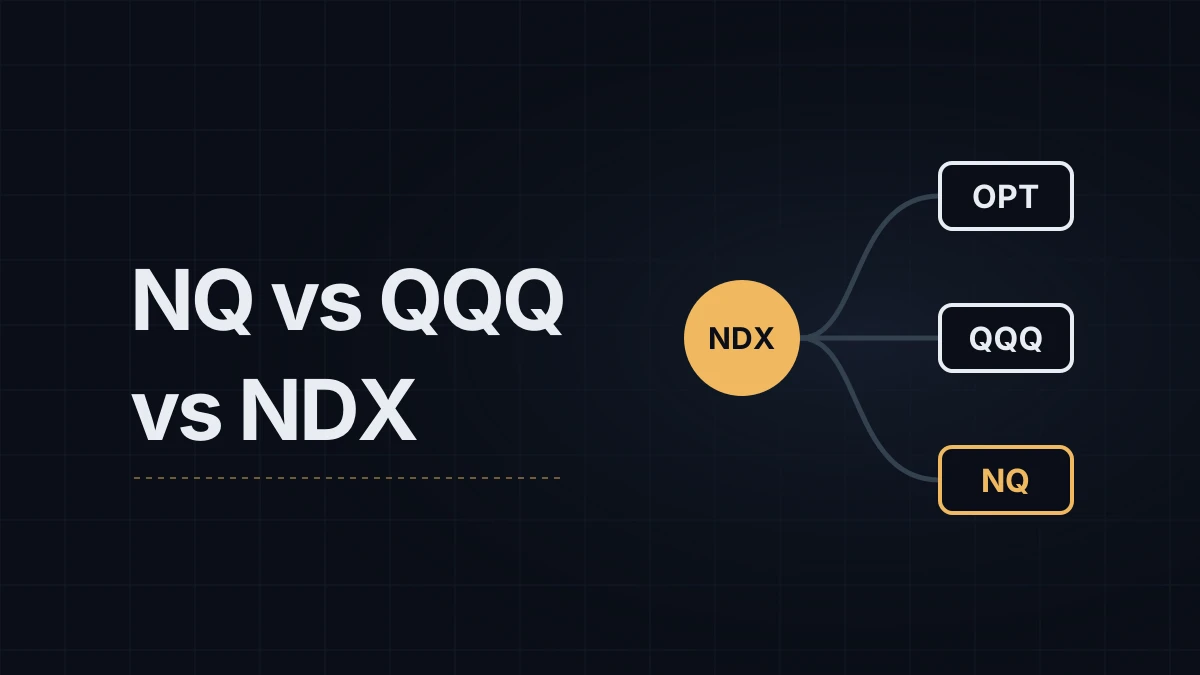
The Nasdaq-100 itself can't be bought. NDX is a number Nasdaq calculates from the prices of 100 of the largest non-financial companies listed on its exchange, and traders reach it through instruments built on top of it: options on the index, the Invesco QQQ ETF, and the E-mini Nasdaq-100 future, NQ, with its micro version MNQ. NQ vs QQQ comes down to size, hours and the way each one charges you. NDX matters to both as the price they track.
If contract terms are new, NQ vs MNQ tick and point value explains them from zero, and Nasdaq-100 weights shows which companies move the index.
| NDX (cash index) | QQQ (ETF) | NQ and MNQ (futures) | |
|---|---|---|---|
| What it is | The index value, tradable only through options | A fund that holds the index stocks | CME futures contracts on the index |
| Price | The index | About NDX ÷ 41 | The index plus financing, minus expected dividends |
| One unit | Option: $100 × index | One share | NQ: $20 × index; MNQ: $2 × index |
| Hours (ET) | Calculated from 9:30 AM, on stock prices | Nasdaq: 4:00 AM to 8:00 PM, core session 9:30 AM to 4:00 PM; broker hours vary | Sunday 6:00 PM to Friday 5:00 PM, daily break 5:00 to 6:00 PM |
| Settlement | Options settle in cash | Shares; its options settle into shares | Cash, at the opening quotation on the third Friday of March, June, September and December |
| Holding cost | Option time decay | 0.18% a year expense ratio | Quarterly roll; financing built into the price |
| Dividends | n/a | Paid quarterly | Not paid; priced into the future |
QQQ is no longer the unit investment trust it was for more than 26 years: Invesco converted it to a standard open-end fund in December 2025 and cut the fee from 0.20% to 0.18% at the same time.
Size: what 100 points is worth
With the index near 31,000, where it traded in early October 2026, one NQ contract controls about $620,000 of index exposure and one MNQ about $62,000. QQQ traded near $755, so 100 shares come to about $75,500.
| Position | A 100-point move in NDX |
|---|---|
| 1 NQ | $2,000 |
| 1 MNQ | $200 |
| 100 QQQ shares | about $243 |
100 shares of QQQ sit between one and two MNQ contracts in size, which matters for anyone moving from ETFs to futures: the first futures position doesn't have to be bigger than the stock position was. NDX options run the other way. At $100 × 31,000, one contract is worth about $3.1 million of index, which is why Nasdaq also lists XND, a micro version at one hundredth of the index.
Leverage and margin
100 QQQ shares bought outright cost the full $75,500; a margin account lends up to half of that for an overnight stock position. A futures position needs only a performance bond. At the time of writing, TradeStation lists overnight maintenance margin of roughly $41,500 to $43,300 for NQ and $4,150 to $4,330 for MNQ, depending on the side, and about 10% more to open the position (CME sets the exchange minimum, and brokers can ask more), so one NQ held overnight carries about 14 times its margin in exposure. Intraday, futures brokers set their own lower rates: TradeStation asks about $238 to open an MNQ day trade and $217 to keep it, a rate that applies from 9:00 AM to 4:00 PM ET with a stop order in place. MNQ margin and leverage shows what that does to a small account.
The pattern day trader rule, which required $25,000 in a margin account for frequent stock and ETF day trading, never applied to futures. It is on its way out for stocks too: the SEC approved FINRA's replacement, an intraday margin standard, in April 2026, effective June 4, 2026, and brokers have until October 2027 to switch over.
What a trade costs
Commissions and fees. Futures charge per contract. Exchange and NFA fees come to about $1.39 per side on NQ and $0.36 on MNQ on TradeStation's schedule at the time of writing, with a clearing fee ($0.10 per side there) and the broker's commission on top; MNQ commissions and fees breaks a round turn down line by line. QQQ shares trade commission-free at most US brokers, with a small regulatory fee on sales.
The spread. Here the instruments are closest. NQ's usual spread during the US session is one tick, 0.25 points: $5 on a $620,000 position, about 0.08 basis points. QQQ's usual spread is one cent on a $755 share, about 0.13 basis points. Per dollar of exposure the future is slightly cheaper to cross; in dollars per position, 100 QQQ shares cost $1 to cross against $0.50 for one MNQ.
Holding costs. QQQ charges its 0.18% a year, about $136 on 100 shares, and passes the index dividends to you, about 0.4% over the last twelve months. A future charges no fee and pays no dividends; its price sits above the cash index by the cost of financing minus expected dividends, and that premium shrinks to zero by expiration. Holding a future for months also means rolling it every quarter, covered in NQ contract months and rollover. For a day trader none of this adds up to much. For a position held a year it is most of the comparison.
Tax treatment differs as well. In the US, futures and broad-based index options such as NDX fall under Section 1256 (60% long-term, 40% short-term, however long the position was held), and QQQ shares don't. That is a question for a tax adviser, and the rules depend on where you live.
Hours
The cash index only moves while stocks trade. QQQ trades in Nasdaq's extended session from 4:00 AM to 8:00 PM ET, with thin volume and wider spreads outside 9:30 AM to 4:00 PM. Broker windows vary: some start later, and some, Interactive Brokers and Schwab among them, already run overnight sessions for US stocks and ETFs. Nasdaq plans its own overnight session and expects it to start on Sunday, December 6, 2026. The SEC approved the longer trading day in April 2026, and the start still depends on the consolidated data feeds being ready. NQ trades around the clock from Sunday evening to Friday afternoon apart from the daily hour off.
For a trader in Europe the difference is concrete. Nasdaq's extended session opens at 10:00 CEST, while NQ has been trading since midnight CEST, through the Asian session and the European morning. In the week from October 25 to November 1, when only Europe has changed its clocks, both times move an hour earlier. The overnight session on NQ covers what happens in those hours.
Which one suits which trader
A buy-and-hold investor in the index gets the simplest deal from QQQ: no roll, no margin call, dividends paid, a fee measured in fractions of a percent. An options trader chooses between NDX (cash-settled, European exercise, large) and QQQ options (settled in shares, American exercise), both with expirations every trading day. An intraday trader, especially one outside US hours, gets longer hours and small, adjustable size from NQ and MNQ, and in a futures prop firm evaluation there is no choice: the account trades futures.
I trade MNQ. The hours fit a European working day, and a prop account doesn't offer anything else.
Educational content, not investment advice. Futures trading involves substantial risk of loss. Examples are for illustration only. Read the full Risk Disclosure.